Publications
kept in sync with arXiv automatically
This list is generated from arXiv every night. See also Google Scholar.
2026
- Stability of Quantum LDPC States under Local Pauli NoiseTai-Hsuan Yang, Andrew D. Kim, Akash Vijay, and Jong Yeon LeearXiv preprint arXiv:2610.22357, Oct 2026
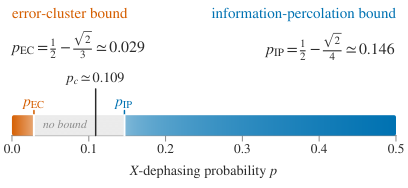
Quantum low-density parity-check (qLDPC) codes have a canonical mixed state—the normalized projector onto the code space—that lies at the intersection of quantum error correction and quantum many-body physics, yet the stability of its information-theoretic structure under local noise remains poorly understood. Recent progress on mixed-state phases of matter has identified the spatial decay of conditional mutual information (CMI) I(A:C|B) as a key diagnostic of such stability, analogous to the role of the spectral gap for quantum ground states. We prove that, for the normalized code-projector state of a \mathbbZ_d qLDPC stabilizer code under local Pauli noise, the CMI across a buffer B separating A from C decays exponentially with the width of B in two complementary noise regimes independent of system size. At weak noise, this holds for full-system tripartitions, where correlations between the two sides require an error cluster to cross the buffer, an exponentially unlikely event. At strong noise, exponential decay holds whenever the buffer supports no logical operator, since correlations can persist only along rare chains of buffer qudits that remain informative. Under an additional space-uniformity assumption, we establish the robustness of Levin–Wen topological entropy. On finite-dimensional lattices of size n, the weak-noise bound further implies a constant-layer quasi-local Petz recovery channel of range O(\poly(\log n)/\varepsilon) that recovers the noiseless state within trace-distance error \varepsilon. Both CMI bounds apply to general qLDPC interaction graphs, including geometries where such constant-depth quasi-local recovery need not exist. Thus, the exponential decay of the noise-induced CMI provides a general criterion for mixed-state phase stability.
@article{yang2026stability, title = {Stability of Quantum LDPC States under Local Pauli Noise}, author = {Yang, Tai-Hsuan and Kim, Andrew D. and Vijay, Akash and Lee, Jong Yeon}, journal = {arXiv preprint arXiv:2610.22357}, year = {2026}, month = oct, } - Logical CCZ state cultivationYuta Hirasaki and Jong Yeon LeearXiv preprint arXiv:2610.20591, Oct 2026
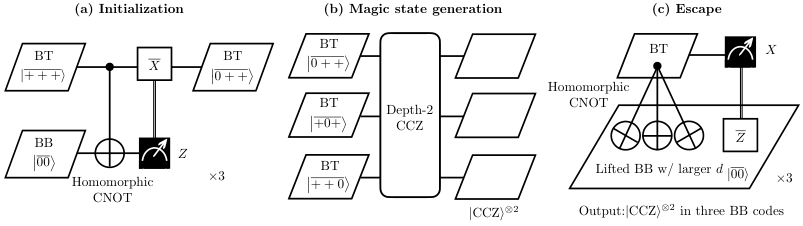
Logical CCZ states enable Toffoli gates, a central building block of fault-tolerant quantum arithmetic. We introduce an end-to-end protocol for direct CCZ-state preparation on bivariate tricycle and bicycle (BT/BB) codes. Our factory combines the cup-product CCZ gates native to BT codes with two novel ingredients, both enabled by engineering the logical coupling between BT and BB codes through projection-preserving lifts. Index-2 lifted BB ancillas enable selective Z-basis initialization, allowing the native cup-product gates to directly prepare two disjoint logical CCZ states. The prepared CCZ states are faithfully transferred to index-3 lifted BB memories with high code distance. We use decoder-based postselection to obtain high-fidelity output states with low overhead. We perform exact simulations of our factory under a circuit-level noise model motivated by neutral-atom hardware, obtaining joint infidelities of 1.84\times10^-5 at 21.94\% acceptance and 4.10\times10^-7 at 8.89\% acceptance for single-qubit, CZ, and CCZ error rates of 0.01\%, 0.1\%, and 0.5\%, respectively. At the output-infidelity target of our smallest factory, its estimated spacetime cost per CCZ state is lower than that of T-state cultivation followed by CCZ conversion, providing an efficient route to logical CCZ states for fault-tolerant quantum computation.
@article{hirasaki2026logical, title = {Logical CCZ state cultivation}, author = {Hirasaki, Yuta and Lee, Jong Yeon}, journal = {arXiv preprint arXiv:2610.20591}, year = {2026}, month = oct, } - Short-Range Vector Spin Glasses: Parisi Hierarchies and Real-Space UltrametricityAkash Vijay, Jaewon Kim, and Jong Yeon LeearXiv preprint arXiv:2610.12441, Oct 2026
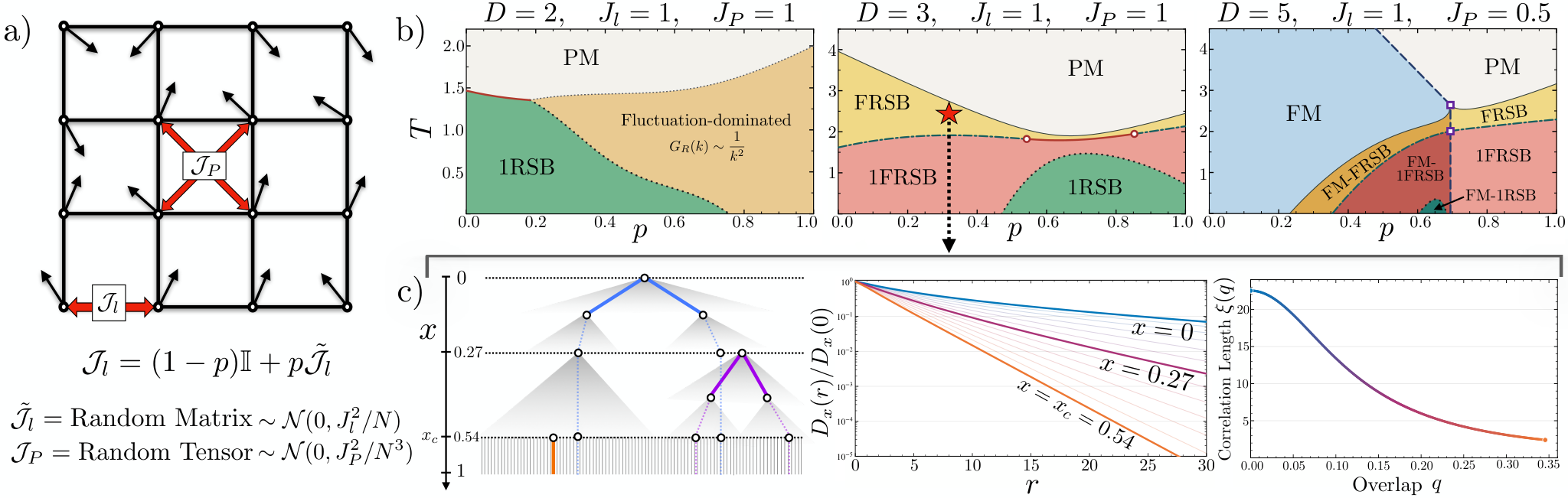
Replica symmetry breaking (RSB) is the organizing principle of mean-field spin-glass theory, yet whether a continuous Parisi hierarchy can arise in a genuinely short-range system in finite spatial dimension remains unresolved. Here we introduce a disordered model of N-component vector spins on a D-dimensional hypercubic lattice, with random matrix couplings on nearest-neighbor links and random tensor couplings on elementary plaquettes. In the large-N limit, the model supports thermodynamically stable one-step, full, and one-full RSB phases, alongside replica-symmetric paramagnetic and ferromagnetic phases. We find that spatial locality constrains these ordered phases through two distinct infrared mechanisms. (i) Quenched random anisotropy destroys uniform ferromagnetism for D\leq4 through an Imry-Ma mechanism. (ii) A continuous Parisi hierarchy gives rise to replica Goldstone modes whose gaplessness is protected by a Ward identity. At leading order in 1/N, these modes behave as a band of free spin waves, producing infrared-divergent fluctuations in D\leq2 and a Mermin-Wagner instability of the continuously broken phase. Remarkably, the Parisi hierarchy also acquires a direct real-space interpretation. For two pure states with mutual overlap q, a characteristic length ξ(q) describes how far the differences between their frozen magnetization patterns remain correlated. Throughout a continuous sector of the Parisi hierarchy, ξ(q) is independent of temperature and decreases monotonically with q. The ultrametric organization of pure states is therefore accompanied by an ultrametric hierarchy of real-space correlation lengths: states that separate near the root of the Parisi tree differ through long-wavelength frozen patterns, whereas states that separate farther from the root differ only on progressively shorter scales.
@article{vijay2026shortrange, title = {Short-Range Vector Spin Glasses: Parisi Hierarchies and Real-Space Ultrametricity}, author = {Vijay, Akash and Kim, Jaewon and Lee, Jong Yeon}, journal = {arXiv preprint arXiv:2610.12441}, year = {2026}, month = oct, } - Designing Group-Valued Codes with Full Regular Low-Weight BasesJong Yeon LeearXiv preprint arXiv:2610.06820, Oct 2026
Efficient fault-tolerant quantum computing architectures benefit from low-weight logical operators. However, reported canonical bases for high-rate, high-distance codes can be several times heavier than the code distance, and fundamental obstructions can prevent minimum-weight logical operators from forming a complete canonical basis. To address this issue, we develop design principles for group-valued quantum error-correcting codes with low-weight full regular canonical logical bases, generated by translating a set of seed operators. We introduce frame width f, the smallest weight cutoff that permits a complete canonical logical basis, as an additional code parameter alongside distance d and check weight w. Cataloguing these parameters together with explicit logical bases can inform resource estimates and the compilation of fault-tolerant logical operations. First, we identify a structural obstruction: for fully populated binary monomial CSS checks over a group of odd order, full regularity forces distance two, while for groups of power-of-two order, full row rank of both check matrices after replacing every group element by 1 guarantees full regularity. Second, we demonstrate our principles through explicit high-rate lifted-product (LP) and pair-partition (PP) codes: an [[1088,128,22]] LP code with f=22 and an [[1024,256,24]] PP code with f ≤27, both at w=10. At w=11, our PP constructions attain either d=25 with f ≤27 or d=24 with the proved optimum f=25, demonstrating both a tradeoff among these parameters and a strict separation between distance and frame width. Finally, we propose a method combining symmetry reduction and stabilizer-based pruning for exhaustive distance certification, and use it to efficiently establish exact distances for LP examples with more than a thousand qubits.
@article{lee2026designing, title = {Designing Group-Valued Codes with Full Regular Low-Weight Bases}, author = {Lee, Jong Yeon}, journal = {arXiv preprint arXiv:2610.06820}, year = {2026}, month = oct, } - Design Principles for Ultra-High-Rate Quantum CodesJong Yeon Lee, Koki Okada, Nishad Maskara, Kenta Kasai, and Hengyun ZhouarXiv preprint arXiv:2609.30069, Sep 2026
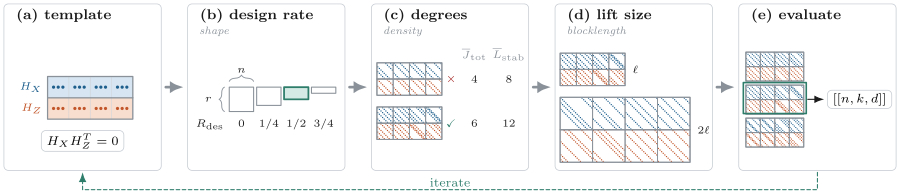
Reducing the qubit overhead of quantum error correction is a central challenge for scalable fault-tolerant quantum computing. Recent ultra-high-rate quantum codes offer a promising route toward this goal, with some constructions requiring as few as two physical data qubits per logical qubit. However, systematic principles for navigating the tradeoffs among encoding rate, distance, check weight, and blocklength remain lacking. Here, we develop and analyze principles for exploring this design space, and use them to design compact code constructions with improved performance. We develop code templates based on a pair-partition construction and a halving transformation that further reduces blocklength. Motivated by ensemble analysis of the degree distributions, we identify column weight as a key design parameter: increasing the column weight enables larger distances at compact blocklengths, at the cost of heavier checks. We find that at physical error rates of 0.1%, the benefits of increased distance often outweigh the penalty associated with heavier checks. Applying this framework, we identify numerous compact codes with favorable parameters, including [[90,21,11]], [[140,31,15]], and [[200,43,20]] non-CSS codes with check weight 10. Moreover, we develop symmetry-informed strategies for identifying low-weight logical bases. These results provide systematic strategies for designing ultra-high-rate quantum codes and navigating their Pareto frontier.
@article{lee2026design, title = {Design Principles for Ultra-High-Rate Quantum Codes}, author = {Lee, Jong Yeon and Okada, Koki and Maskara, Nishad and Kasai, Kenta and Zhou, Hengyun}, journal = {arXiv preprint arXiv:2609.30069}, year = {2026}, month = sep, } - Transparent Domain Walls through Information Convex SetsJintae Kim, Amanda Gatto Lamas, Jacopo Gliozzi, Bowen Shi, Taylor L. Hughes, and Jong Yeon LeearXiv preprint arXiv:2609.26892, Sep 2026
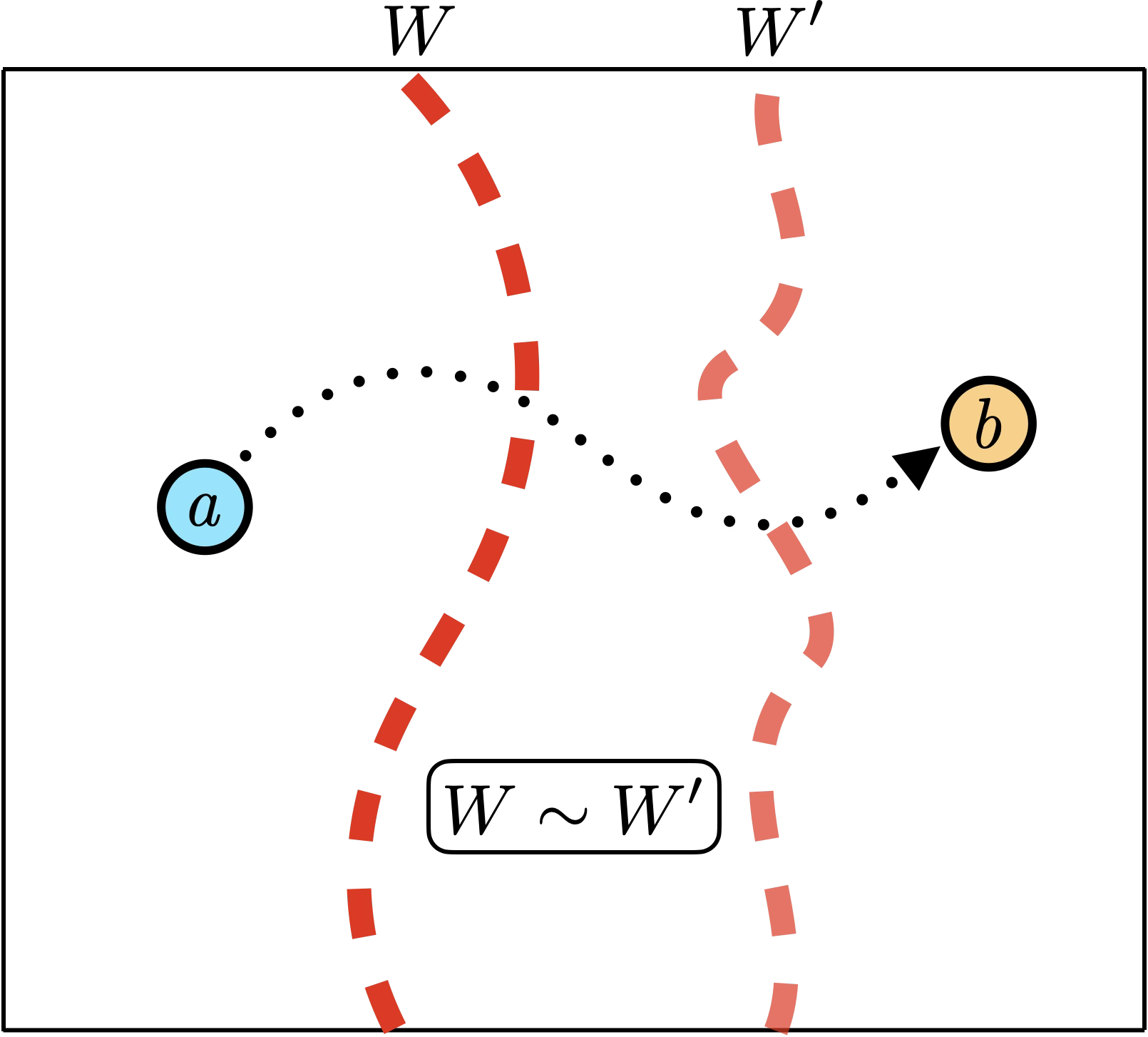
In (2+1)-dimensional topologically ordered many-body states, transparent (topologically deformable) domain walls are invisible to local topological probes, yet can modify the ground state degeneracy (GSD) and transmute anyons transported across them. Here, we develop an entanglement-bootstrap framework using information convex sets (ICSs) on local and noncontractible annuli to extract information about transparent domain walls directly from ground state wavefunctions at fixed points of Abelian topological phases on a torus, without taking categorical defect data as input. We derive fusion rules governing the action of anyons on extreme points of ICSs on noncontractible annuli and determine their quantum dimensions. Extreme points invariant under transport around the complementary cycle correspond one-to-one to minimum entropy states (MESs), and their number equals the GSD. The maximal topological entanglement entropy (TEE), γ_\rm LW^\max=\log(\mathcalD/d_α), probes the net effect of walls crossing the chosen annulus, where \mathcalD is the total quantum dimension and d_α is the quantum dimension of an extreme point of its ICS. In contrast, the maximal entanglement asymmetry is ΔS_X^\max=\log\mathrmGSD. This value is the same for both annulus orientations and reflects the combined effect of the transparent domain walls. We further show that transparent domain walls can give rise to symmetries supported jointly on the two chosen fundamental cycles that cannot be decomposed into a product of two 1-form symmetry operators, one supported on each cycle. By relating their action on MESs to anyon tunneling and the fusion rules, we clarify how these symmetries connect distinct ground states. Additionally, we apply the framework to Wen’s plaquette model, the anisotropic dipolar toric code, and the rank-2 toric code.
@article{kim2026transparent, title = {Transparent Domain Walls through Information Convex Sets}, author = {Kim, Jintae and Lamas, Amanda Gatto and Gliozzi, Jacopo and Shi, Bowen and Hughes, Taylor L. and Lee, Jong Yeon}, journal = {arXiv preprint arXiv:2609.26892}, year = {2026}, month = sep, } - Hierarchy of Rényi Coherent Information in Stabilizer CodesAkash Vijay, Luis Colmenarez, and Jong Yeon LeearXiv preprint arXiv:2609.11930, Sep 2026
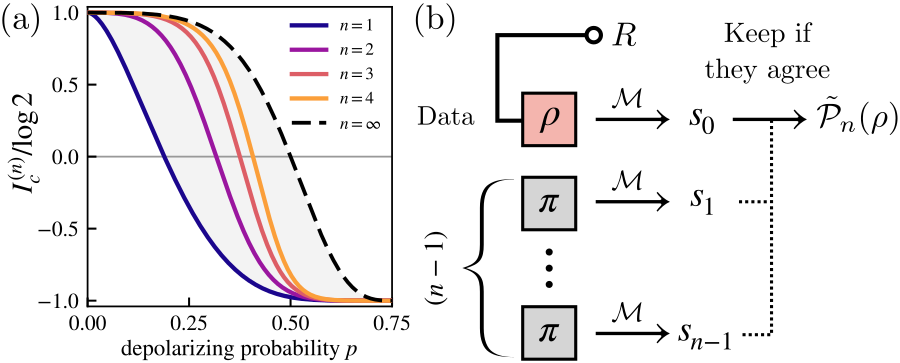
Rényi coherent information, a computable proxy for the von Neumann coherent information, is widely used to study mixed-state phases of matter and decodability transitions in noisy quantum error-correcting codes. However, being a difference of two Rényi entropies, it need not be monotonic in the Rényi index, and lacks the operational meaning of its von Neumann counterpart. Here we address both issues for stabilizer codes. First, for Pauli noise generated by independent Bernoulli events, we prove that the Rényi-n coherent information is nondecreasing in n ∈\mathbbZ^+. This follows from a general theorem: if independent random bits are mapped linearly to a fine label T and a coarse label C, then the Rényi entropy difference H_n(C)-H_n(T) is nondecreasing in n. For stabilizer codes, T is the joint syndrome–logical class and C is the syndrome, and the difference is the Rényi-n coherent information up to a constant. The same theorem covers classical linear codes and independent detector error models. Second, for arbitrary stochastic Pauli noise, we give the Rényi-n coherent information an operational meaning via postselection on matching syndromes between one data block and n-1 auxiliary blocks. We determine when this defines a quantum channel and show that saturation of the Rényi-n coherent information is equivalent to asymptotically perfect recovery of the postselected channel. Moreover, the Rényi-n coherent information also upper-bounds the ordinary coherent information achievable after any syndrome-conditioned recovery.
@article{vijay2026hierarchy, title = {Hierarchy of Rényi Coherent Information in Stabilizer Codes}, author = {Vijay, Akash and Colmenarez, Luis and Lee, Jong Yeon}, journal = {arXiv preprint arXiv:2609.11930}, year = {2026}, month = sep, } - Approximate Quantum Error Correction at Chiral Topological EdgesYuntai Song, Zejun Liu, Zhencheng Wang, Jong Yeon Lee, and Bowen ShiarXiv preprint arXiv:2608.06258, Aug 2026
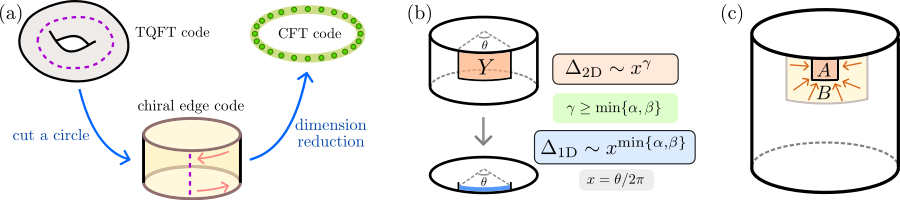
Topologically ordered phases naturally realize quantum error correction through nonlocal encoding of quantum information. More recently, conformal field theories have been shown to realize approximate quantum error-correcting codes, but such constructions generally require fine tuning to criticality. Here we introduce a family of approximate quantum error-correcting codes realized by the chiral edges of two-dimensional topologically ordered phases. The proposed encoding combines the robustness of a gapped topological bulk with the flexibility of gapless edge conformal field theories. To characterize its robustness, we study coherent-information loss under local erasure. We derive an exact expression relating coherent-information loss to relative entropy, reducing the recoverability problem to universal properties of the edge theory. This leads to power-law scaling of coherent-information loss with the size of the erased region. We further show that, for geometrically local erasures near one edge, the two-dimensional chiral edge code is at least as robust as the dimensionally reduced CFT code, and is strictly more robust in several representative examples. For Abelian code subspaces, we further construct a power-law-range recovery map supported on the erased region together with a power-law-range buffer; this recovery map depends only on the code subspace, not on the unknown encoded state. We provide numerical calculations for lattice realizations of compact free boson and Ising CFT examples that support the theoretical predictions of the power-law exponents.
@article{song2026approximate, title = {Approximate Quantum Error Correction at Chiral Topological Edges}, author = {Song, Yuntai and Liu, Zejun and Wang, Zhencheng and Lee, Jong Yeon and Shi, Bowen}, journal = {arXiv preprint arXiv:2608.06258}, year = {2026}, month = aug, } - Lifting Lifted Product CodesYuta Hirasaki and Jong Yeon LeearXiv preprint arXiv:2607.28621, Jul 2026
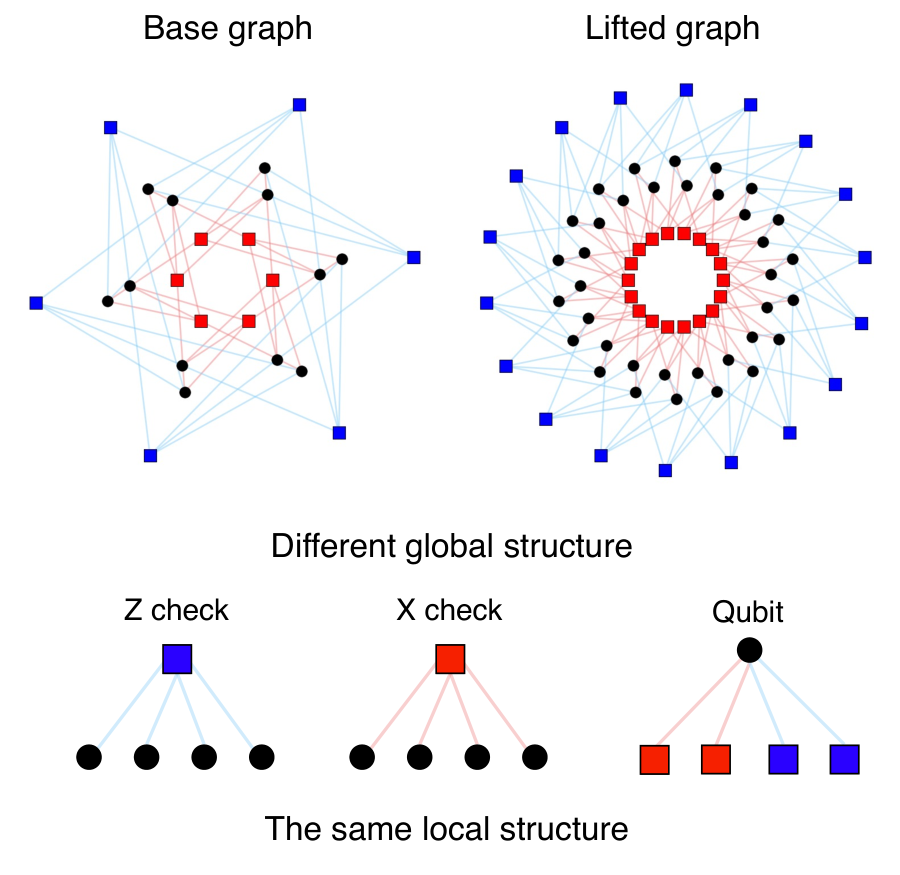
Lifted product (LP) codes form an important class of quantum error correcting codes with favorable code parameters. We introduce a systematic construction of LP code families based on group extensions and graph lifts. The construction increases the code size while preserving the local structure of the Tanner graph, and relates code parameters, logical operators, and fault-tolerant logical-operation gadgets within the families through chain and cochain maps. As a first application, we obtain LP codes with better code parameters than previously reported ones. We then demonstrate that code-surgery gadgets can be transferred across the selected finite lifts through chain maps and, in several cases, implemented with lower space overhead. We also develop parallel product surgery for lifted clustered cyclic codes. Finally, we propose lifting as a systematic first step toward defining thermodynamic families for algebraically defined qLDPC codes without an underlying Euclidean lattice. For several base codes and selected lifts, coherent information exhibits finite-size crossings, while our results also indicate that additional conditions are needed to determine a unique family.
@article{hirasaki2026lifting, title = {Lifting Lifted Product Codes}, author = {Hirasaki, Yuta and Lee, Jong Yeon}, journal = {arXiv preprint arXiv:2607.28621}, year = {2026}, month = jul, } - Monte Carlo Studies of Twisted Bilayer Graphene: Strain and Thermal FluctuationsJohannes S. Hofmann, Patrick Ledwith, Ashvin Vishwanath, Jong Yeon Lee, and Erez BergarXiv preprint arXiv:2607.20619, Jul 2026
We study the phase diagram of twisted bilayer graphene at charge neutrality as a function of twist angle θ, uniaxial heterostrain \varepsilon, and temperature T using sign-problem-free quantum Monte Carlo simulations. At T=0 and zero strain, we find a continuous transition from a Dirac semimetal to a gapped Kramers inter-valley coherent (KIVC) phase as θ decreases toward the magic angle. With finite strain, the KIVC phase undergoes a further continuous transition at smaller θ into an anisotropic semimetal with gapless excitations near the center of the moiré Brillouin zone. In the KIVC regime, the entropy rises sharply with temperature and plateaus at 15\,\textK ≲T ≲40\,\textK near the value expected from a Mott-like regime of localized electrons with nearly uncorrelated spin, valley, and orbital degrees of freedom, despite the topological obstruction preventing a localized tight-binding description of the active bands. The spectral function evolves continuously with θ: at low T, a gap opens at the K points and the minimal gap shifts to Γ as θ decreases; at intermediate T, the spectral function smoothly interpolates between a Dirac semimetal spectrum with coherent K-point quasiparticles and a spectrum with gapless Γ-centered quasiparticles near the magic angle. The later can be a anisotropic or a Mott semimetal and we discuss how to distiguish them in experiment.
@article{hofmann2026monte, title = {Monte Carlo Studies of Twisted Bilayer Graphene: Strain and Thermal Fluctuations}, author = {Hofmann, Johannes S. and Ledwith, Patrick and Vishwanath, Ashvin and Lee, Jong Yeon and Berg, Erez}, journal = {arXiv preprint arXiv:2607.20619}, year = {2026}, month = jul, } - Logical Spectroscopy: Lifted-Product Codes with Addressable BasesJong Yeon LeearXiv preprint arXiv:2607.05386, Jul 2026
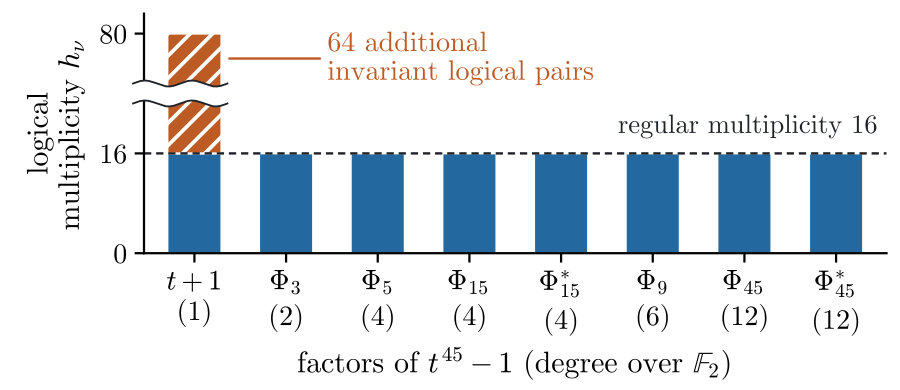
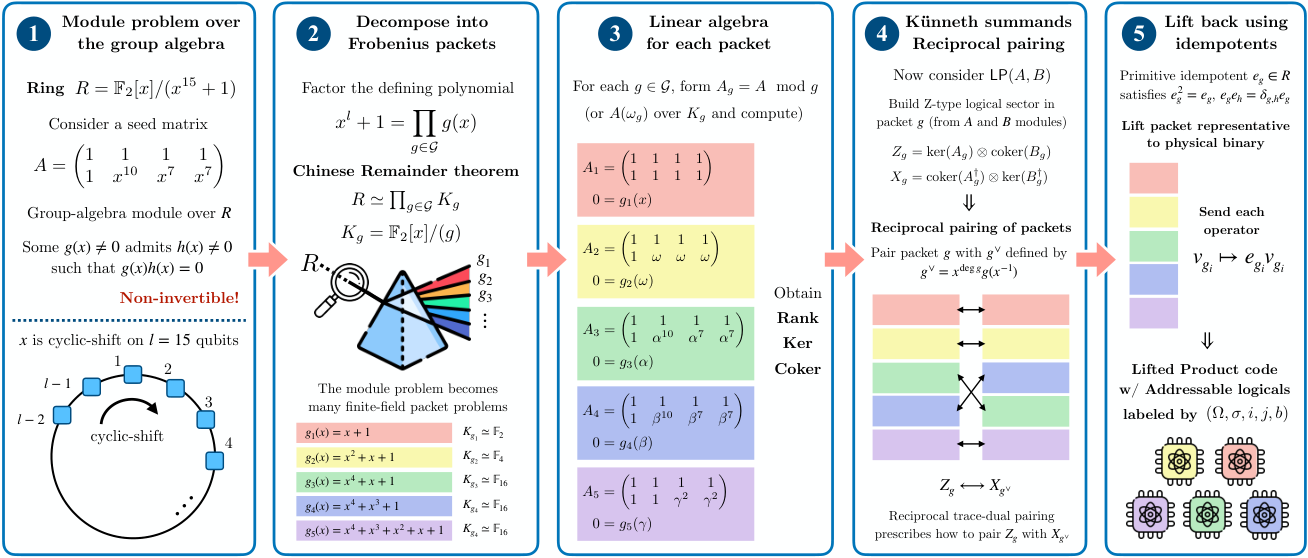
Quantum LDPC memories can encode many logical qubits, but that alone does not make them usable: applications need to know where the logical operators are supported, how they are labeled, and how conjugate X/Z partners pair. For hypergraph-product codes this information follows from row reduction over \mathbbF_2. For Abelian lifted-product codes, which include prominent high-rate constructions, it does not: the entries of the defining seed matrices live in a group algebra rather than a field, so pivots need not be invertible and row reduction can fail. To address this problem, we introduce \emphlogical spectroscopy. For an odd-order Abelian lift group, the Chinese remainder theorem splits the group algebra into finite fields, one for each Frobenius orbit of characters; we call these orbits packets. Packet by packet, we solve ordinary finite-field linear algebra, lift the answers back to the physical code with the associated packet projectors, and pair X and Z logicals between reciprocal packets by trace duality. The result is a complete conjugate logical basis for a finite Abelian lifted product code that is addressable: every logical coordinate carries canonical packet and Künneth-summand labels, deterministic within-block indices, a conjugate partner, and an explicit binary representative. The code’s own translation symmetry then acts on these coordinates in closed form. We apply the construction to examples with up to 5000 physical qubits, including high-rate examples whose distance-witness is reported explicitly. We further extend the decomposition to even-order lifts. Logical spectroscopy thus equips Abelian lifted products with an explicit logical coordinate system and an algebraic toolkit for high-rate code search.
@article{lee2026logical, title = {Logical Spectroscopy: Lifted-Product Codes with Addressable Bases}, author = {Lee, Jong Yeon}, journal = {arXiv preprint arXiv:2607.05386}, year = {2026}, month = jul, } - Charge Scrambling in Strong-to-Weak Spontaneous Symmetry BreakingJong Yeon LeearXiv preprint arXiv:2605.05288, May 2026
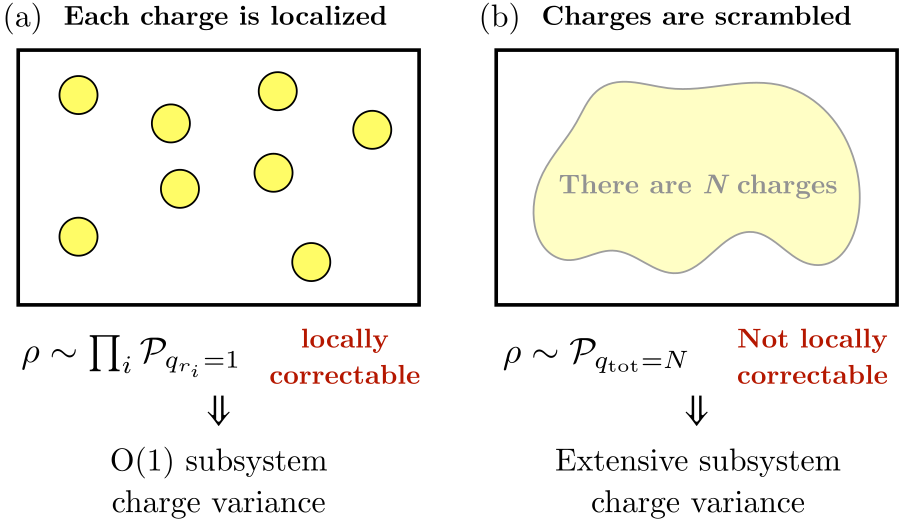
Strong-to-weak spontaneous symmetry breaking (SWSSB) is diagnosed by nonlinear correlators, but its direct static implication for conserved charge fluctuations is not automatic. We show that, for continuous symmetries, long-range Rényi-1 correlator, together with a sufficiently rapid approach to its nonzero asymptotic value, forces subsystem charge indefiniteness: the block-charge variance has an extensive lower bound; equivalently, the truncated symmetry expectation has extensive curvature. This gives a precise static fluctuation footprint of charge scrambling. We construct examples to show that the implication is conditional and non-reversible: dephased superfluids retain Rényi-1 SWSSB with subextensive charge variance when the Rényi-1 tail is too slow, while sparse fixed-charge projectors have extensive charge variance but no local charge-transfer Rényi-1 order or long-range conditional mutual information. Finally, we introduce a \emphtwist overlap correlator, which serves as an analogue of charge variance applicable to both discrete and continuous symmetries. This naturally decomposes local block-charge fluctuations into strong- and weak-symmetry channels. We found that the weak-symmetry channel isolates coherent charge fluctuations and is directly related to the Wigner–Yanase skew information. Taken together, these results give a unified understanding for distinguishing nonlinear SWSSB order, local charge indefiniteness, and coherent charge fluctuations.
@article{lee2026charge, title = {Charge Scrambling in Strong-to-Weak Spontaneous Symmetry Breaking}, author = {Lee, Jong Yeon}, journal = {arXiv preprint arXiv:2605.05288}, year = {2026}, month = may, } - Liouvillian Gap in Dissipative Haar-Doped Clifford CircuitsHa Eum Kim, Andrew D. Kim, and Jong Yeon LeearXiv preprint arXiv:2602.03234, Feb 2026
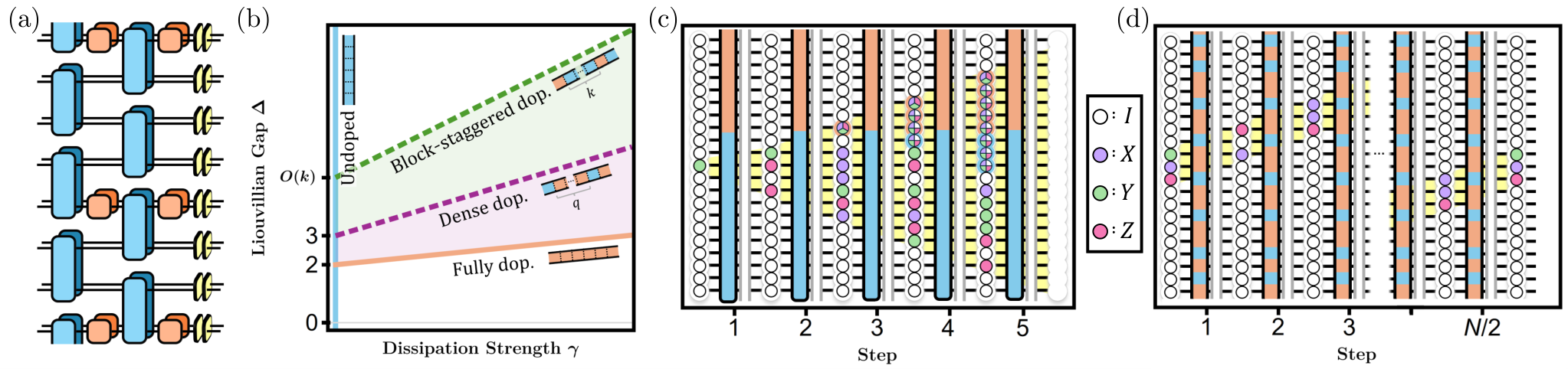
Quantum chaos is commonly assessed through probe-dependent signatures that need not coincide. Recently, a dissipative signature was proposed for chaotic Floquet systems, where infinitesimal bulk dissipation induces a non-zero constant intrinsic relaxation rate quantified by the Liouvillian gap. This raises a question: what minimal departure from Clifford dynamics is required to generate such intrinsic relaxation? To address this, we study a Floquet two-qubit Clifford circuit doped with Haar-random single-qubit gates and subject to local dissipation of strength γ. We find a structure-dependent crossover. The undoped iSWAP-class circuit exhibits a weak-dissipation singularity, with a gap that grows with N for any γ>0. Haar doping preserves this undoped-like growth for any subextensive doping pattern. At finite doping density, there exist patterns that yield an \mathcalO(1) gap for any fixed γ as N\to∞, yet remain singular as γ\to0^+. Because our bounds depend only on the spatial doping pattern, they remain valid even when the Haar rotations are independently redrawn each Floquet period. Overall, our findings provide a circuit-level perspective on intrinsic relaxation, and thus irreversibility, in open many-body systems.
@article{kim2026liouvillian, title = {Liouvillian Gap in Dissipative Haar-Doped Clifford Circuits}, author = {Kim, Ha Eum and Kim, Andrew D. and Lee, Jong Yeon}, journal = {arXiv preprint arXiv:2602.03234}, year = {2026}, month = feb, } - Topological Mixed States: Phases of Matter from Axiomatic ApproachesTai-Hsuan Yang, Bowen Shi, and Jong Yeon LeePhys. Rev. X, 2026
Featured by Illinois Physics: Classifying non-equilibrium phases of matter (Oct. 2, 2026).
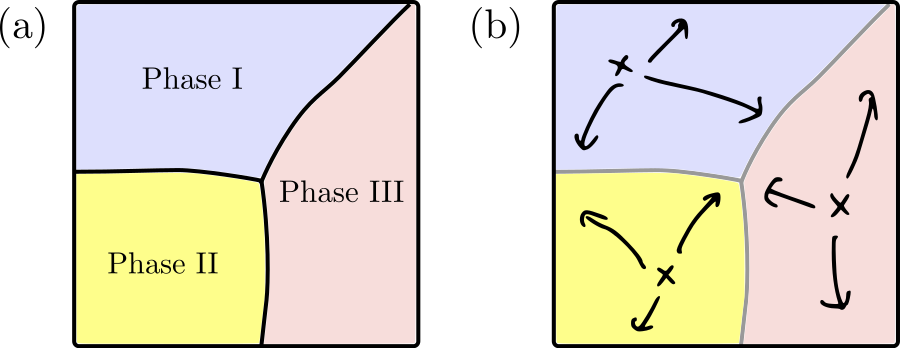
For closed quantum systems, topological orders are understood through the equivalence classes of ground states of gapped local Hamiltonians. The generalization of this conceptual paradigm to open quantum systems, however, remains elusive, often relying on operational definitions without fundamental principles. Here, we fill this gap by proposing an approach based on three axioms: (i) local recoverability, (ii) absence of long-range correlations, and (iii) spatial uniformity. States that satisfy these axioms are fixed points; requiring the axioms only after coarse-graining promotes each fixed point to an equivalence class, i.e., a phase, presenting the first step towards the axiomatic classification of mixed-state phases of matter: mixed-state bootstrap program. From these axioms, a rich set of topological data naturally emerges; importantly, these data are robust under relaxation of axioms. For example, each topological mixed state supports locally indistinguishable classical and/or quantum logical memories with distinct responses to topological operations. These data label distinct mixed-state phases, allowing one to distinguish them. We further uncover a hierarchy of secret-sharing constraints: in non-Abelian phases, reliable recovery-even of information that looks purely classical-demands a specific coordination among spatial subregions, a requirement different across non-Abelian classes. This originates from non-Abelian fusion rules that can stay robust under decoherence. Finally, we performed large-scale numerical simulations to corroborate stability: weakly decohered fixed points respect the axioms once coarse-grained. These results lay the foundation for a systematic classification of topological states in open quantum systems.
@article{yang2025topological, title = {Topological Mixed States: Phases of Matter from Axiomatic Approaches}, author = {Yang, Tai-Hsuan and Shi, Bowen and Lee, Jong Yeon}, journal = {Phys. Rev. X}, volume = {16}, pages = {041002}, year = {2026}, doi = {10.1103/3bpt-f9pd}, } - Gauging Modulated Symmetries via Multiple Gauge Symmetry Operators and Adaptive Quantum CircuitsJintae Kim, Jong Yeon Lee, and Jung Hoon HanPhys. Rev. B, 2026
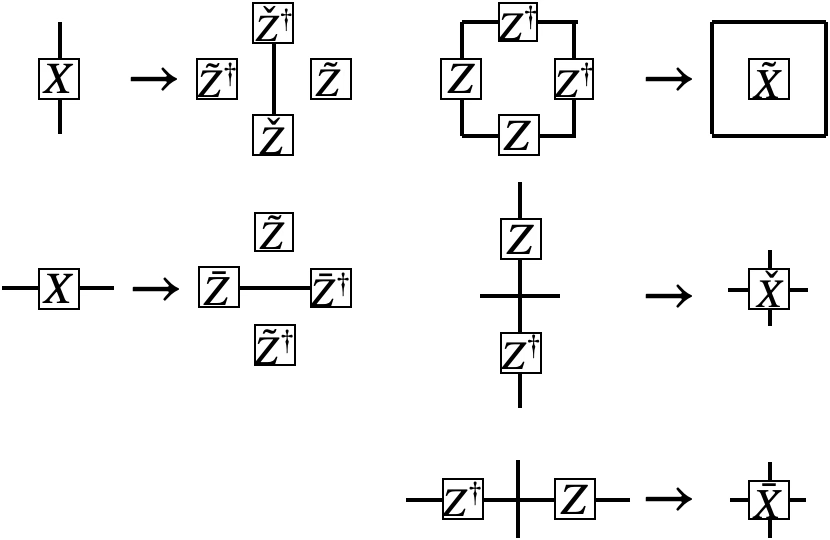
We introduce an extended framework for the simultaneous gauging of modulated symmetries in (d+1) dimensions, employing \it multiple gauge symmetry operators whose corresponding gauging procedures must be carried out simultaneously. Simultaneous gauging can capture a broader class of dualities than sequential gauging, the latter corresponding to the conventional gauging applied in successive steps. In general, performing simultaneous gauging and conventional gauging in sequence constitutes the most general framework for gauging modulated symmetries. We further show that the associated duality transformations can be implemented via adaptive state preparation protocols. As a concrete example, we consider a dipole symmetry in (2+1)D and illustrate both the simultaneous gauging procedure and the adaptive preparation protocol. Interestingly, we find that the intermediate state of the simultaneous gauging/adaptive circuit corresponds to a symmetry-protected topological phase protected by the dipole bundle symmetry. Finally, we utilize the duality to analyze the phase diagram of the rank-2 toric code under transverse fields.
@article{kim2025gauging, title = {Gauging Modulated Symmetries via Multiple Gauge Symmetry Operators and Adaptive Quantum Circuits}, author = {Kim, Jintae and Lee, Jong Yeon and Han, Jung Hoon}, journal = {Phys. Rev. B}, volume = {113}, pages = {085139}, year = {2026}, doi = {10.1103/xg4h-vqv1}, } - Error Threshold of SYK Codes from Strong-to-Weak Parity Symmetry BreakingJaewon Kim, Ehud Altman, and Jong Yeon LeePhys. Rev. B, 2026
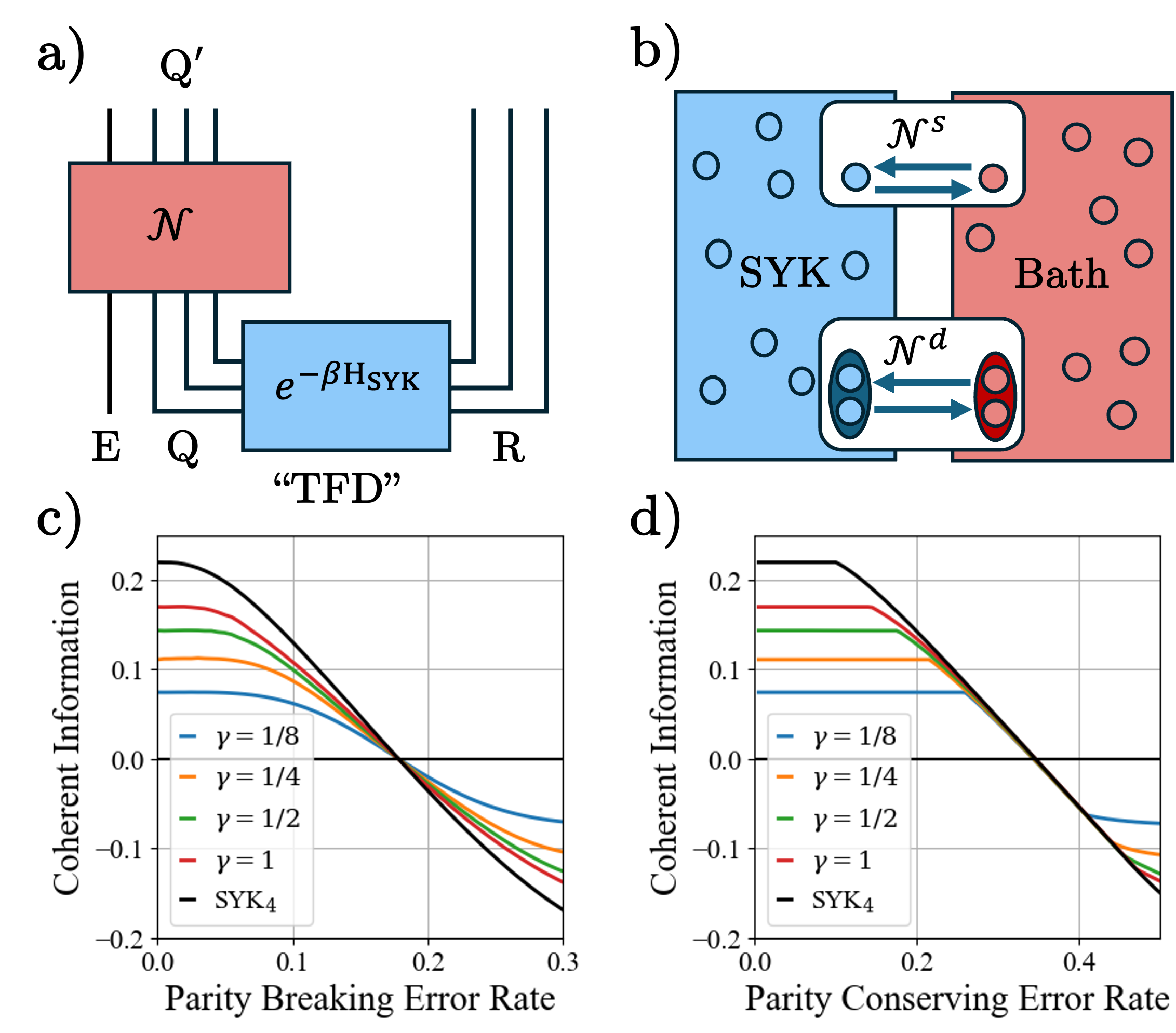
Quantum error correction (QEC) codes are fundamentally linked to quantum phases of matter: the degenerate ground state manifold corresponds to the code space, while topological excitations represent error syndromes. Building on this concept, the Sachdev-Ye-Kitaev (SYK) model, characterized by its extensive quasi-ground state degeneracy, serves as a constant rate approximate QEC code. In this work, we study the impacts of decoherence on the information-theoretic capacity of SYK models and their variants. Such a capacity is closely tied to traversable wormholes via its thermofield double state, which theoretically enables the teleportation of information across a black hole. We calculate the coherent information in the maximally entangled quasi-ground state space of the SYK models under the fermion parity breaking and parity conserving noise. Interestingly, we find that under the strong fermion parity symmetric noise, the mixed state undergoes the strong to weak spontaneous symmetry breaking of fermion parity, which also corresponds to the information-theoretic transition. Our results highlight the degradation of wormhole traversability in realistic quantum scenarios, as well as providing critical insights into the behavior of approximate constant-rate QEC codes under decoherence.
@article{kim2024error,
  title = {Error Threshold of SYK Codes from Strong-to-Weak Parity Symmetry Breaking},
  author = {Kim, Jaewon and Altman, Ehud and Lee, Jong Yeon},
  journal = {Phys. Rev. B},
  volume = {114},
  pages = {L051101},
  year = {2026},
  doi = {10.1103/srf2-1f6d},
}
2025
- Information Critical Phases under DecoherenceAkash Vijay and Jong Yeon LeearXiv preprint arXiv:2512.22121, Dec 2025
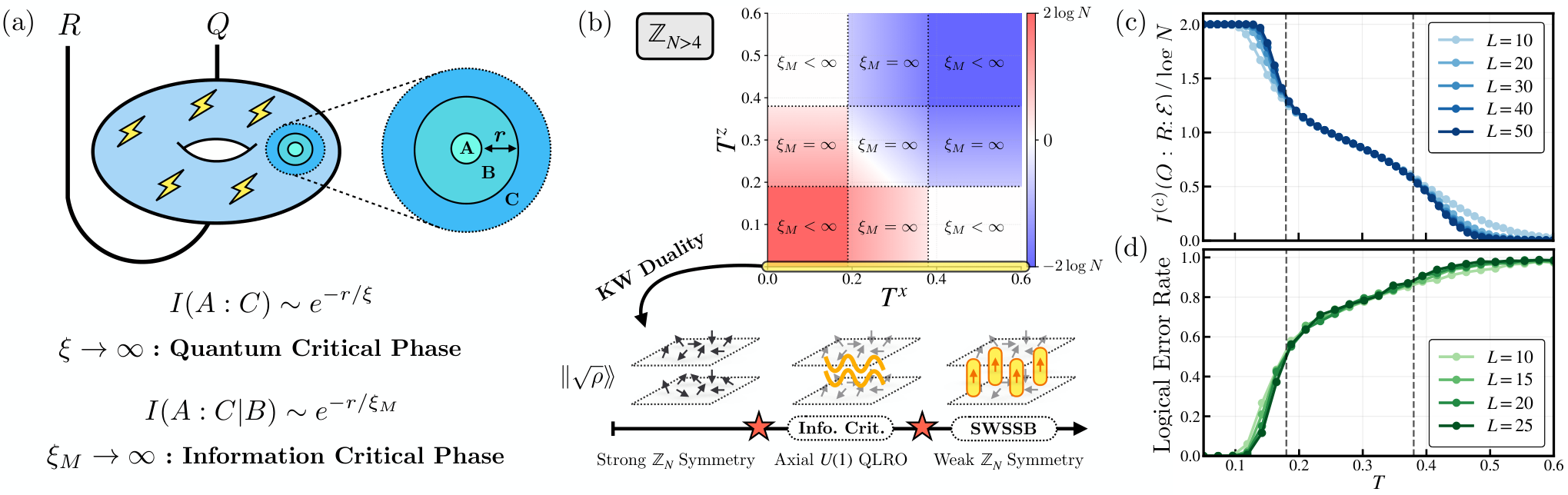
Quantum critical phases are extended regions of phase space characterized by a diverging correlation length. By analogy, we define an \emphinformation critical phase as an extended region of a mixed state phase diagram where the Markov length, the characteristic length scale governing the decay of the conditional mutual information (CMI), diverges. We demonstrate that such a phase arises in decohered \mathbbZ_N toric codes by assessing both the CMI and the coherent information, the latter quantifying the robustness of the encoded logical qudits. For N>4, we find that the system hosts an information critical phase intervening between the decodable and non-decodable phases where the coherent information saturates to a fractional value in the thermodynamic limit, indicating that a finite fraction of logical information is still preserved. We show that the density matrix in this phase can be decomposed into a convex sum of Coulombic pure states, where gapped anyons reorganize into gapless photons. We further consider the ungauged \mathbbZ_N toric code and interpret its mixed state phase diagram in the language of strong-to-weak spontaneous symmetry breaking. We argue that in the dual model, the information critical phase arises because the spontaneously broken off-diagonal \mathbbZ_N symmetry gets enhanced to a U(1) symmetry, resulting in a novel superfluid phase whose gapless modes involve coherent excitations of both the system and the environment. Finally, we propose an optimal decoding protocol for the corrupted \mathbbZ_N toric code and show that its logical error rate saturates to a fractional value in the information critical phase. Our findings identify a gapless analog for mixed-state phases that still acts as a fractional topological quantum memory, thereby extending the conventional paradigm of quantum memory phases.
@article{vijay2025information, title = {Information Critical Phases under Decoherence}, author = {Vijay, Akash and Lee, Jong Yeon}, journal = {arXiv preprint arXiv:2512.22121}, year = {2025}, month = dec, } - Holographically Emergent Gauge Theory in Symmetric Quantum CircuitsAkash Vijay and Jong Yeon LeearXiv preprint arXiv:2511.21685, Nov 2025
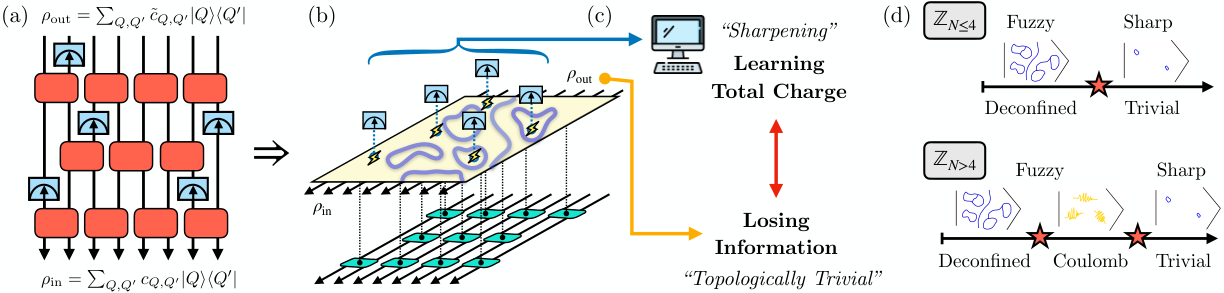
We develop a novel holographic framework to study dynamical phases in random quantum circuits with a global symmetry G. Viewing the circuit as a tensor network, we decompose it into two parts: a symmetric layer, which defines an emergent gauge wavefunction in one higher dimension, and a non-symmetric layer, composed of random multiplicity tensors. For G\,=\,\mathbbZ_N symmetric circuits consisting of local unitary gates interspersed with local symmetric noise channels, averaging over the non-symmetric layer yields a dynamically generated noisy \mathbbZ_N surface code. This allows us to interpret \mathbbZ_N symmetric circuits in the volume-law phase as quantum error-correcting codes with a distinguished set of logical spin states that inherit the topological protection of the bulk code. By establishing equality of bulk and boundary coherent information, we show that quantum information encoded in these logical states is maximally protected against symmetric noise up to a finite threshold. We further study weakly monitored \mathbbZ_N symmetric circuits which exhibit a charge-sharpening transition. We show that the point at which the observer gains classical information about the global charge coincides with the point at which measurements destroy the underlying quantum information encoded in the bulk surface code. This also allows for a natural interpretation of the sharpening transition as a confinement transition in the gauge theory. For N\,≤ 4, weak measurements drive a single transition from a charge-fuzzy phase with exponential sharpening time t_\#∼e^L to a charge-sharp phase with t_\#∼\mathcalO(1). On the other hand, for N>4, the circuit can enter an intermediate phase with a linear sharpening time t_\#∼\mathcalO(L). In this regime, the bulk gauge theory realizes a Coulomb phase with emergent gapless photons.
@article{vijay2025holographically, title = {Holographically Emergent Gauge Theory in Symmetric Quantum Circuits}, author = {Vijay, Akash and Lee, Jong Yeon}, journal = {arXiv preprint arXiv:2511.21685}, year = {2025}, month = nov, } - Evidence for a \mathbbZ_2 Dirac spin liquid in the generalized Shastry-Sutherland modelAtanu Maity, Francesco Ferrari, Sylvain Capponi, Karlo Penc, Janik Potten, Tobias Müller, and 5 more authorsarXiv preprint arXiv:2501.00096, Jan 2025
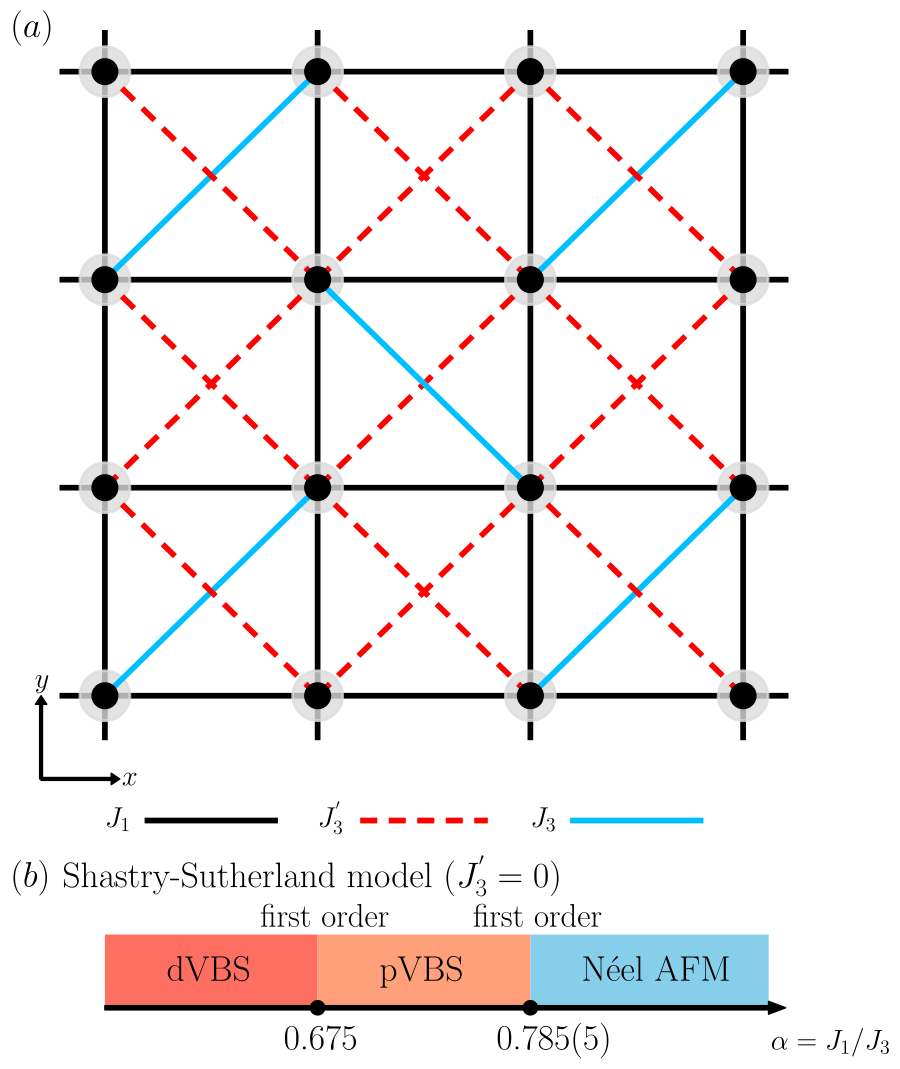
We present a multimethod investigation of the recently reported quantum spin liquid (QSL) phase in the spin-1/2 Heisenberg antiferromagnet on the Shastry-Sutherland lattice. A comprehensive projective symmetry group classification of fermionic mean-field Ansätze on this lattice yields 46 U(1) and 80 \mathbbZ_2 states. Using density-matrix renormalization group (DMRG) and exact diagonalization, we find that the Shastry-Sutherland model and the square-lattice J_1-J_2 Heisenberg antiferromagnet share the same QSL phase. We therefore map our Ansätze to those on the square lattice and identify the counterpart of the square-lattice \mathbbZ_2 Dirac QSL (Z2Azz13) in the Shastry-Sutherland system. Using state-of-the-art variational Monte Carlo with Gutzwiller-projected wavefunctions improved by Lánczos steps, we demonstrate excellent agreement in energies and correlation functions between a gapless (Dirac) \mathbbZ_2 spin liquid, characterized by only a few variational parameters, and results from neural quantum states and DMRG. Within a unified variational family that continuously connects the spin liquid to the adjacent Néel and plaquette valence-bond-crystal states, we locate both phase boundaries in an unbiased way from order-parameter finite-size scaling and correlation-ratio crossings, and find that both order parameters vanish continuously. Finally, the recently developed Keldysh formulation of the pseudo-fermion functional renormalization group yields a dynamical spin structure factor with features consistent with Dirac cones, providing strong independent evidence for a Dirac QSL ground state. Our identification of a d-wave pairing \mathbbZ_2 Dirac QSL is consistent with recently observed signatures of QSL behavior in Pr_2Ga_2BeO_7 and makes predictions for future experiments.
@article{maity2025evidence, title = {Evidence for a $\mathbb{Z}_{2}$ Dirac spin liquid in the generalized Shastry-Sutherland model}, author = {Maity, Atanu and Ferrari, Francesco and Capponi, Sylvain and Penc, Karlo and Potten, Janik and Müller, Tobias and Feuerpfeil, Andreas and Thomale, Ronny and Lee, Jong Yeon and Samajdar, Rhine and Iqbal, Yasir}, journal = {arXiv preprint arXiv:2501.00096}, year = {2025}, month = jan, } - From the Shastry-Sutherland model to the J_1-J_2 Heisenberg modelXiangjian Qian, Rongyi Lv, Jong Yeon Lee, and Mingpu QinPhys. Rev. B, 2025
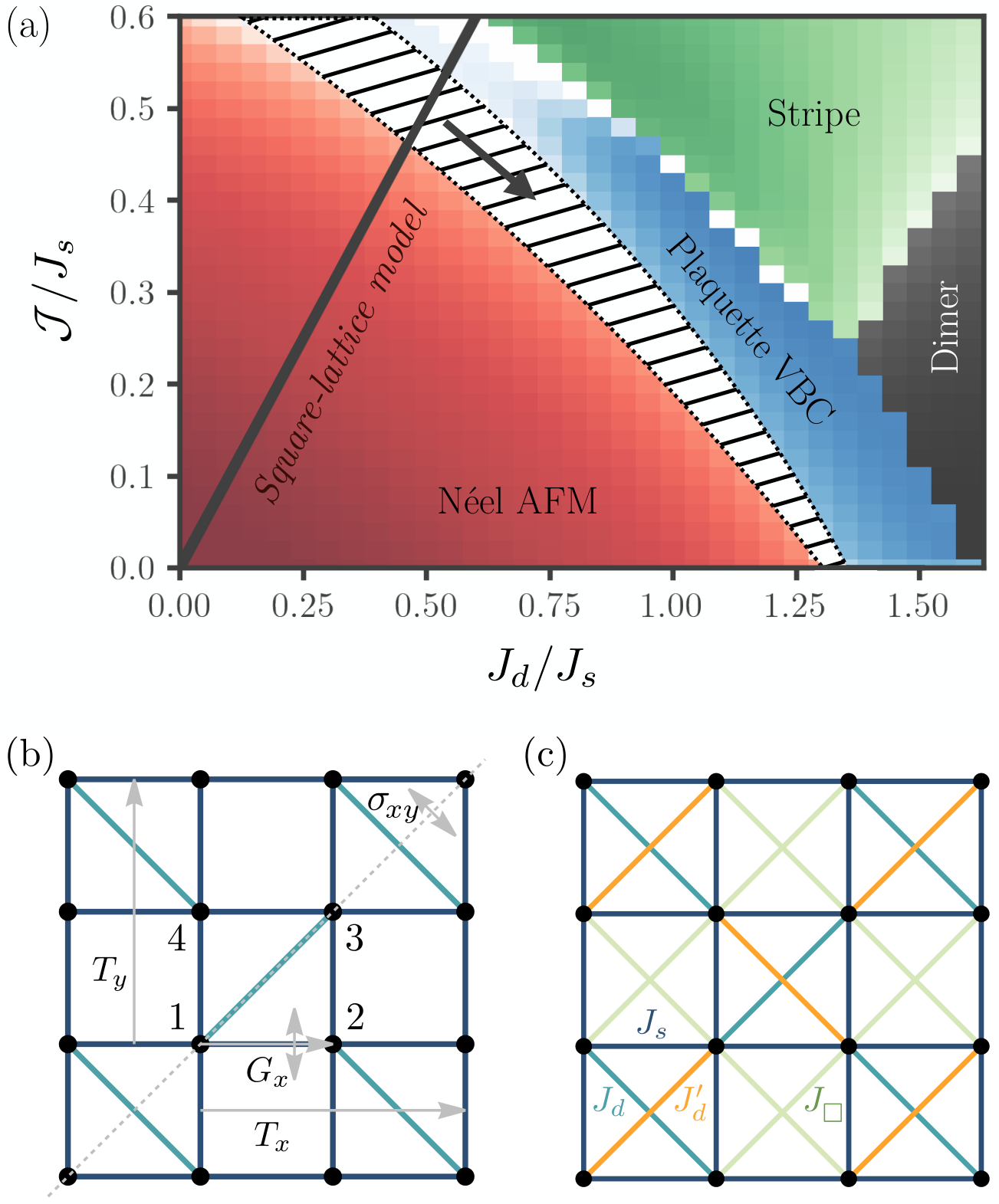
We propose a generalized Shastry-Sutherland model which bridges the Shastry-Sutherland model and the J_1-J_2 Heisenberg model. By employing large scale Density Matrix Renormalization Group and Fully Augmented Matrix Product State calculations, combined with careful finite-size scaling, we find the phase transition between the plaquette valence bond state (PVBS) and Neel anti-ferromagnetic (AFM) phase in the pure Shastry-Sutherland model is a weak first one. This result indicates the existence of an exotic tri-critical point in the PVBS to AFM transition line in the phase diagram, as the transition in the J_1-J_2 Heisenberg model was previously determined to be continuous. We determine the location of the tri-critical point in the phase diagram at which first-order transition turns to continuous. Our generalized Shastry-Sutherland model provides not only a valuable platform to explore exotic phases and phase transitions but also more realistic description of Shastry-Sutherland materials like SrCu_2(BO_3)_2.
@article{qian2024shastrysutherland, title = {From the Shastry-Sutherland model to the $J_1$-$J_2$ Heisenberg model}, author = {Qian, Xiangjian and Lv, Rongyi and Lee, Jong Yeon and Qin, Mingpu}, journal = {Phys. Rev. B}, volume = {111}, pages = {L241113}, year = {2025}, doi = {10.1103/h6gc-t1wm}, } - Coherent information for CSS codes under decoherenceRyotaro Niwa and Jong Yeon LeePhys. Rev. A, 2025
Stabilizer codes lie at the heart of modern quantum-error-correcting codes (QECC). Of particular importance is a class called Calderbank-Shor-Steane (CSS) codes, which includes many important examples such as toric codes, color codes, and fractons. Recent studies have revealed that the decoding transition for these QECCs could be intrinsically captured by calculating information-theoretic quantities from the mixed state. Here we perform a simple analytic calculation of the coherent information for general CSS codes under local incoherent Pauli errors via diagonalization of the density matrices and mapping to classical statistical mechanical (SM) models. Our result establishes a rigorous connection between the decoding transition of the quantum code and the phase transition in the random classical SM model. It is also directly confirmed for CSS codes that exact error correction is possible if and only if the maximum-likelihood (ML) decoder always succeeds in the thermodynamic limit. Thus, the fundamental threshold is saturated by the optimal decoder.
@article{niwa2024coherent, title = {Coherent information for CSS codes under decoherence}, author = {Niwa, Ryotaro and Lee, Jong Yeon}, journal = {Phys. Rev. A}, volume = {111}, pages = {032402}, year = {2025}, doi = {10.1103/PhysRevA.111.032402}, } - Exact Calculations of Coherent Information for Toric Codes under Decoherence: Identifying the Fundamental Error ThresholdJong Yeon LeePhys. Rev. Lett., 2025
The toric code is a canonical example of a topological error-correcting code. Two logical qubits stored within the toric code are robust against local decoherence, ensuring that these qubits can be faithfully retrieved as long as the error rate remains below a certain threshold. Recent studies have explored such a threshold behavior as an intrinsic information-theoretic transition, independent of the decoding protocol. These studies have shown that information-theoretic metrics, calculated using the Renyi (replica) approximation, demonstrate sharp transitions at a specific error rate. However, an exact analytic expression that avoids using the replica trick has not been shown, and the connection between the transition in information-theoretic capacity and the random bond Ising model (RBIM) has only been indirectly established. In this work, we present the first analytic expression for the coherent information of a decohered toric code, thereby establishing a rigorous connection between the fundamental error threshold and the criticality of the RBIM.
@article{lee2024exact, title = {Exact Calculations of Coherent Information for Toric Codes under Decoherence: Identifying the Fundamental Error Threshold}, author = {Lee, Jong Yeon}, journal = {Phys. Rev. Lett.}, volume = {134}, pages = {250601}, year = {2025}, doi = {10.1103/hlfh-86yz}, } - Symmetry protected topological phases under decoherenceJong Yeon Lee, Yi-Zhuang You, and Cenke XuQuantum, 2025
We study ensembles described by density matrices with potentially nontrivial topological features. In particular, we study a class of symmetry protected topological (SPT) phases under various types of decoherence, which can drive a pure SPT state into a mixed state. We demonstrate that the system can still retain the nontrivial topological information from the SPT ground state even under decoherence. In the "doubled Hilbert space", we provide a general definition for symmetry protected topological ensemble (SPT ensemble), and the main quantity that we investigate is various types of (boundary) anomalies in the doubled Hilbert space. We show that the notion of the strange correlator, previously proposed to as a diagnosis for the SPT ground states, can be generalized to capture these anomalies in mixed-state density matrices. Using both exact calculations of the stabilizer Hamiltonians and field theory evaluations, we demonstrate that under decoherence the nontrivial features of the SPT state can persist in the two types of strange correlators: type-I and type-II. We show that the nontrivial type-I strange correlator corresponds to the presence of the SPT information that can be efficiently identified and utilized from experiments, such as for the purpose of preparing for long-range entangled states. The nontrivial type-II strange correlator encodes the full topological response of the decohered mixed state density matrix, i.e., the information about the presence of the SPT state before decoherence. Therefore, our work provides a unified framework to understand decohered SPT phases from the information-theoretic viewpoint.
@article{lee2022symmetry, title = {Symmetry protected topological phases under decoherence}, author = {Lee, Jong Yeon and You, Yi-Zhuang and Xu, Cenke}, journal = {Quantum}, volume = {9}, pages = {1607}, year = {2025}, doi = {10.22331/q-2025-01-23-1607}, } - The Future of the Correlated Electron ProblemA. Alexandradinata, N. P. Armitage, Andrey Baydin, Wenli Bi, Yue Cao, Hitesh J. Changlani, and 41 more authorsSciPost Phys. Comm. Rep., 2025
A central problem in modern condensed matter physics is the understanding of materials with strong electron correlations. Despite extensive work, the essential physics of many of these systems is not understood and there is very little ability to make predictions in this class of materials. In this manuscript we share our personal views on the major open problems in the field of correlated electron systems. We discuss some possible routes to make progress in this rich and fascinating field. This manuscript is the result of the vigorous discussions and deliberations that took place at Johns Hopkins University during a three-day workshop January 27, 28, and 29, 2020 that brought together six senior scientists and 46 more junior scientists. Our hope, is that the topics we have presented will provide inspiration for others working in this field and motivation for the idea that significant progress can be made on very hard problems if we focus our collective energies.
@article{alexandradinata2020future,
  title = {The Future of the Correlated Electron Problem},
  author = {Alexandradinata, A. and Armitage, N. P. and Baydin, Andrey and Bi, Wenli and Cao, Yue and Changlani, Hitesh J. and Chertkov, Eli and da Silva Neto, Eduardo H. and Delacretaz, Luca and Baggari, Ismail El and Ferguson, G. M. and Gannon, William J. and Ghorashi, Sayed Ali Akbar and Goodge, Berit H. and Goulko, Olga and Grissonnanche, G. and Hallas, Alannah and Hayes, Ian M. and He, Yu and Huang, Edwin W. and Kogar, Anshul and Kumah, Divine and Lee, Jong Yeon and Legros, A. and Mahmood, Fahad and Maximenko, Yulia and Pellatz, Nick and Polshyn, Hryhoriy and Sarkar, Tarapada and Scheie, Allen and Seyler, Kyle L. and Shi, Zhenzhong and Skinner, Brian and Steinke, Lucia and Thirunavukkuarasu, K. and Trevisan, Thaís Victa and Vogl, Michael and Volkov, Pavel A. and Wang, Yao and Wang, Yishu and Wei, Di and Wei, Kaya and Yang, Shuolong and Zhang, Xian and Zhang, Ya-Hui and Zhao, Liuyan and Zong, Alfred},
  journal = {SciPost Phys. Comm. Rep.},
  volume = {8},
  year = {2025},
  doi = {10.21468/SciPostPhysCommRep.8},
}
2024
- Tensor network formulation of symmetry protected topological phases in mixed statesHanyu Xue, Jong Yeon Lee, and Yimu BaoarXiv preprint arXiv:2403.17069, Mar 2024
We define and classify symmetry-protected topological (SPT) phases in mixed states based on the tensor network formulation of the density matrix. In one dimension, we introduce strong injective matrix product density operators (MPDO), which describe a broad class of short-range correlated mixed states, including the locally decohered SPT states. We map strong injective MPDO to a pure state in the doubled Hilbert space and define the SPT phases according to the cohomology class of the symmetry group in the doubled state. Although the doubled state exhibits an enlarged symmetry, the possible SPT phases are also constrained by the Hermiticity and the semi-positivity of the density matrix. We here obtain a complete classification of SPT phases with a direct product of strong G and weak K unitary symmetry given by the cohomology group H^2(G, \textU(1))⊕H^1(K, H^1(G, \textU(1))). The SPT phases in our definition are preserved under symmetric local circuits consisting of non-degenerate channels. This motivates an alternative definition of SPT phases according to the equivalence class of mixed states under a “one-way" connection using symmetric non-degenerate channels. In locally purifiable MPDO with strong symmetry, we prove that this alternative definition reproduces the cohomology classification. We further extend our results to two-dimensional mixed states described by strong semi-injective tensor network density operators and classify the possible SPT phases.
@article{xue2024tensor, title = {Tensor network formulation of symmetry protected topological phases in mixed states}, author = {Xue, Hanyu and Lee, Jong Yeon and Bao, Yimu}, journal = {arXiv preprint arXiv:2403.17069}, year = {2024}, month = mar, } - An architecture for two-qubit encoding in neutral ytterbium-171 atomsZhubing Jia, William Huie, Lintao Li, Won Kyu Calvin Sun, Xiye Hu, Aakash, and 4 more authorsnpj Quantum Information, 2024
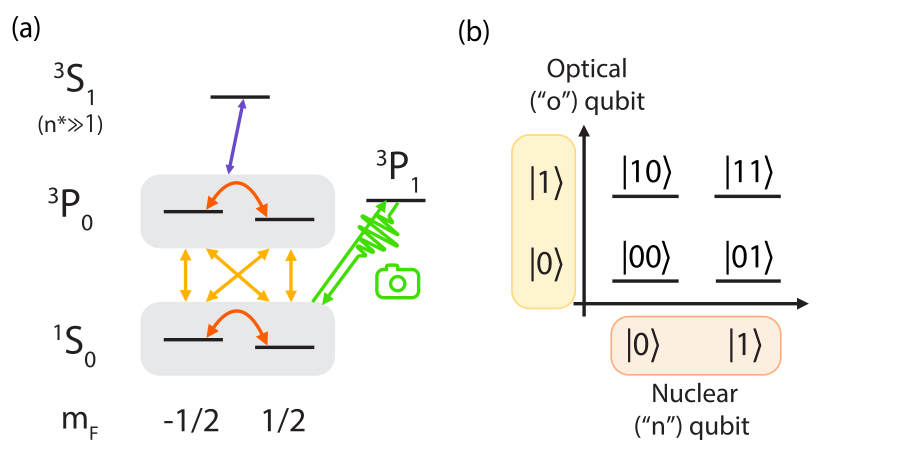
We present an architecture for encoding two qubits within the optical "clock" transition and nuclear spin-1/2 degree of freedom of neutral ytterbium-171 atoms. Inspired by recent high-fidelity control of all pairs of states within this four-dimensional ququart space, we present a toolbox for intra-ququart (single atom) one- and two-qubit gates, inter-ququart (two atom) Rydberg-based two- and four-qubit gates, and quantum nondemolition (QND) readout. We then use this toolbox to demonstrate the advantages of the ququart encoding for entanglement distillation and quantum error correction which exhibit superior hardware efficiency and better performance in some cases since fewer two-atom (Rydberg-based) operations are required. Finally, leveraging single-state QND readout in our ququart encoding, we present a unique approach to studying interactive circuits as well as to realizing a symmetry protected topological phase of a spin-1 chain with a shallow, constant-depth circuit. These applications are all within reach of recent experiments with neutral ytterbium-171 atom arrays or with several trapped ion species.
@article{jia2024architecture, title = {An architecture for two-qubit encoding in neutral ytterbium-171 atoms}, author = {Jia, Zhubing and Huie, William and Li, Lintao and Sun, Won Kyu Calvin and Hu, Xiye and Aakash and Kogan, Healey and Karve, Abhishek and Lee, Jong Yeon and Covey, Jacob P.}, journal = {npj Quantum Information}, volume = {10}, pages = {106}, year = {2024}, doi = {10.1038/s41534-024-00898-7}, } - Spontaneous breaking of U(1) symmetry at zero temperature in one dimensionHaruki Watanabe, Hosho Katsura, and Jong Yeon LeePhys. Rev. Lett., 2024
The Hohenberg–Mermin–Wagner theorem states that there is no spontaneous breaking of continuous symmetries in spatial dimensions d\leq2 at finite temperature. At zero temperature, the classical/quantum mapping further implies the absence of continuous symmetry breaking in one dimension, which is also known as Coleman’s theorem in the context of relativistic quantum field theories. Except for the classic example of the Heisenberg ferromagnet and its variations, there has been no known counterexample to the theorem. In this Letter, we discuss new examples that display spontaneous breaking of a U(1) symmetry at zero temperature, although the order parameter does not commute with the Hamiltonian unlike the Heisenberg ferromagnet. We argue that a more general condition for this behavior is that the Hamiltonian is frustration-free.
@article{watanabe2023spontaneous, title = {Spontaneous breaking of U(1) symmetry at zero temperature in one dimension}, author = {Watanabe, Haruki and Katsura, Hosho and Lee, Jong Yeon}, journal = {Phys. Rev. Lett.}, volume = {133}, pages = {176001}, year = {2024}, doi = {10.1103/PhysRevLett.133.176001}, } - Stable measurement-induced Floquet enriched topological orderDinhDuy Vu, Ali Lavasani, Jong Yeon Lee, and Matthew P. A. FisherPhys. Rev. Lett., 2024
The Floquet code utilizes a periodic sequence of two-qubit measurements to realize the topological order. After each measurement round, the instantaneous stabilizer group can be mapped to a honeycomb toric code, explaining the topological feature. The code also possesses a time-crystal order - the e-m transmutation after every cycle, breaking the Floquet symmetry of the measurement schedule. This behavior is distinct from the stationary topological order realized in either random circuits or time-independent Hamiltonian. Therefore, the resultant phase belongs to the overlap between the classes of Floquet enriched topological orders and measurement-induced phases. In this work, we construct a continuous path interpolating between the Floquet and toric codes, focusing on the transition between the time-crystal and stationary topological phases. We show that this transition is characterized by a divergent length scale. We also add single-qubit perturbations to the model and obtain a richer two-dimensional parametric phase diagram of the Floquet code, showing the stability of the Floquet enriched topological order.
@article{vu2023stable,
  title = {Stable measurement-induced Floquet enriched topological order},
  author = {Vu, DinhDuy and Lavasani, Ali and Lee, Jong Yeon and Fisher, Matthew P. A.},
  journal = {Phys. Rev. Lett.},
  volume = {132},
  pages = {070401},
  year = {2024},
  doi = {10.1103/PhysRevLett.132.070401},
}
2023
- Unifying Emergent Hydrodynamics and Lindbladian Low Energy Spectra across Symmetries, Constraints, and Long-Range InteractionsOlumakinde Ogunnaike, Johannes Feldmeier, and Jong Yeon LeePhys. Rev. Lett., 2023
We identify emergent hydrodynamics governing charge transport in Brownian random circuits with various symmetries, constraints, and ranges of interactions. This is accomplished via a mapping between the averaged dynamics and the low energy spectrum of a Lindblad operator, which acts as an effective Hamiltonian in a doubled Hilbert space. By explicitly constructing dispersive excited states of this effective Hamiltonian using a single mode approximation, we provide a comprehensive understanding of diffusive, subdiffusive, and superdiffusive relaxation in many-body systems with conserved multipole moments and variable interaction ranges. Our approach further allows us to identify exotic Krylov-space-resolved hydrodynamics exhibiting diffusive relaxation despite the presence of dipole conservation, which we verify numerically. Our approach provides a general and versatile framework to qualitatively understand the dynamics of conserved operators under random unitary time evolution.
@article{ogunnaike2023unifying, title = {Unifying Emergent Hydrodynamics and Lindbladian Low Energy Spectra across Symmetries, Constraints, and Long-Range Interactions}, author = {Ogunnaike, Olumakinde and Feldmeier, Johannes and Lee, Jong Yeon}, journal = {Phys. Rev. Lett.}, year = {2023}, doi = {10.1103/PhysRevLett.131.220403}, volume = {131}, pages = {220403} } - Quantum criticality under decoherence or weak measurementJong Yeon Lee, Chao-Ming Jian, and Cenke XuPRX Quantum, 2023
Decoherence inevitably happens when a quantum state is exposed to its environment, which can affect quantum critical points (QCP) in a nontrivial way. As was pointed out in recent literature on (1+1)d conformal field theory (CFT), the effect of weak measurement can be mathematically mapped to the problem of boundary CFT. In this work, we focus on the (2+1)d QCPs, whose boundary and defect effects have attracted enormous theoretical and numerical interests very recently. We focus on decoherence caused by weak measurements with and without post-selecting the measurement outcomes. Our main results are: (1) for an O(N) Wilson-Fisher QCP under weak measurement with post-selection, an observer would in general observe two different types of boundary/defect criticality with very different behaviors from the well-known Wilson-Fisher fixed points; in particular, it is possible to observe the recently proposed exotic "extraordinary-log" correlation. (2) An extra quantum phase transition can be driven by decoherence, if we consider quantities nonlinear with the decohered density matrix, such as the Renyi entropy. We demonstrate the connection between this transition to the information-theoretic transition driven by an error in the toric code model. (3) When there is no post-selection, though correlation functions between local operators remain the same as the undecohered pure state, nonlocal operators such as the "disorder operator" would have qualitatively distinct behaviors; and we also show that the decoherence can lead to confinement.
@article{lee2023quantum, title = {Quantum criticality under decoherence or weak measurement}, author = {Lee, Jong Yeon and Jian, Chao-Ming and Xu, Cenke}, journal = {PRX Quantum}, volume = {4}, pages = {030317}, year = {2023}, doi = {10.1103/PRXQuantum.4.030317}, } - Exact Many-Body Ground States from Decomposition of Ideal Higher Chern Bands: Applications to Chirally Twisted Graphene MultilayersJunkai Dong, Patrick J. Ledwith, Eslam Khalaf, Jong Yeon Lee, and Ashvin VishwanathPhys. Rev. Research, 2023
Motivated by the higher Chern bands of twisted graphene multilayers, we consider flat bands with arbitrary Chern number C with ideal quantum geometry. While C>1 bands differ from Landau levels, we show that these bands host exact fractional Chern insulator (FCI) ground states for short range interactions. We show how to decompose ideal higher Chern bands into separate ideal bands with Chern number 1 that are intertwined through translation and rotation symmetry. The decomposed bands admit an SU(C) action that combines real space and momentum space translations. Remarkably, they also allow for analytic construction of exact many-body ground states, such as generalized quantum Hall ferromagnets and FCIs, including flavor-singlet Halperin states and Laughlin ferromagnets in the limit of short-range interactions. In this limit, the SU(C) action is promoted to a symmetry on the ground state subspace. While flavor singlet states are translation symmetric, the flavor ferromagnets correspond to translation broken states and admit charged skyrmion excitations corresponding to a spatially varying density wave pattern. We confirm our analytic predictions with numerical simulations of ideal bands of twisted chiral multilayers of graphene, and discuss consequences for experimentally accessible systems such as monolayer graphene twisted relative to a Bernal bilayer.
@article{dong2022exact, title = {Exact Many-Body Ground States from Decomposition of Ideal Higher Chern Bands: Applications to Chirally Twisted Graphene Multilayers}, author = {Dong, Junkai and Ledwith, Patrick J. and Khalaf, Eslam and Lee, Jong Yeon and Vishwanath, Ashvin}, journal = {Phys. Rev. Research}, volume = {5}, pages = {023166}, year = {2023}, doi = {10.1103/PhysRevResearch.5.023166}, } - Landau-Forbidden Quantum Criticality in Rydberg Quantum SimulatorsJong Yeon Lee, Joshua Ramette, Max A. Metlitski, Vladan Vuletic, Wen Wei Ho, and Soonwon ChoiPhys. Rev. Lett., 2023
The Landau-Ginzburg-Wilson theory of phase transitions precludes a continuous transition between two phases that spontaneously break distinct symmetries. However, quantum mechanical effects can intertwine the symmetries, giving rise to an exotic phenomenon called deconfined quantum criticality (DQC). In this work, we study the ground state phase diagram of a one-dimensional array of individually trapped neutral atoms interacting strongly via Rydberg states, and demonstrate through extensive numerical simulations that it hosts a variety of symmetry-breaking phases and their transitions including DQC. We show how an enlarged, emergent continuous symmetry arises at the DQCs, which can be experimentally observed in the joint distribution of two distinct order parameters, obtained within measurement snapshots in the standard computational basis. Our findings highlight quantum simulators of Rydberg atoms not only as promising platforms to experimentally realize such exotic phenomena, but also as unique ones allowing access to physical properties not obtainable in traditional experiments.
@article{lee2022landauforbidden,
  title = {Landau-Forbidden Quantum Criticality in Rydberg Quantum Simulators},
  author = {Lee, Jong Yeon and Ramette, Joshua and Metlitski, Max A. and Vuletic, Vladan and Ho, Wen Wei and Choi, Soonwon},
  journal = {Phys. Rev. Lett.},
  volume = {131},
  pages = {083601},
  year = {2023},
  doi = {10.1103/PhysRevLett.131.083601},
}
2022
- Decoding Measurement-Prepared Quantum Phases and Transitions: from Ising model to gauge theory, and beyondJong Yeon Lee, Wenjie Ji, Zhen Bi, and Matthew P. A. FisherarXiv preprint arXiv:2208.11699, Aug 2022
Measurements allow efficient preparation of interesting quantum many-body states with long-range entanglement, conditioned on additional transformations based on measurement outcomes. Here, we demonstrate that the so-called conformal quantum critical points (CQCP) can be obtained by performing general single-site measurements in an appropriate basis on the cluster states in d\geq2. The equal-time correlators of the said states are described by correlation functions of certain d-dimensional classical models at finite temperatures and feature spatial conformal invariance. This establishes an exact correspondence between the measurement-prepared critical states and conformal field theories of a range of critical spin models, including familiar Ising models and gauge theories. Furthermore, by mapping the long-range entanglement structure of measured quantum states into the correlations of the corresponding thermal spin model, we rigorously establish the stability condition of the long-range entanglement in the measurement-prepared quantum states deviating from the ideal setting. Most importantly, we describe protocols to decode the resulting quantum phases and transitions without post-selection, thus transferring the exponential measurement complexity to a polynomial classical computation. Therefore, our findings suggest a novel mechanism in which a quantum critical wavefunction emerges, providing new practical ways to study quantum phases and conformal quantum critical points.
@article{lee2022decoding, title = {Decoding Measurement-Prepared Quantum Phases and Transitions: from Ising model to gauge theory, and beyond}, author = {Lee, Jong Yeon and Ji, Wenjie and Bi, Zhen and Fisher, Matthew P. A.}, journal = {arXiv preprint arXiv:2208.11699}, year = {2022}, month = aug, } - Fermionic Monte Carlo study of a realistic model of twisted bilayer grapheneJohannes S. Hofmann, Eslam Khalaf, Ashvin Vishwanath, Erez Berg, and Jong Yeon LeePhys. Rev. X, 2022
The rich phenomenology of twisted bilayer graphene (TBG) near the magic angle is believed to arise from electron correlations in topological flat bands. An unbiased approach to this problem is highly desirable, but also particularly challenging, given the multiple electron flavors, the topological obstruction to defining tight binding models and the long-ranged Coulomb interactions. While numerical simulations of realistic models have thus far been confined to zero temperature, typically excluding some spin or valley species, analytic progress has relied on fixed point models away from the realistic limit. Here we present for the first time unbiased Monte Carlo simulations of realistic models of magic angle TBG at charge-neutrality. We establish the absence of a sign problem for this model in a momentum space approach, and describe a computationally tractable formulation that applies even on breaking chiral symmetry and including band dispersion. Our results include (i) the emergence of an insulating Kramers inter-valley coherent ground state in competition with a correlated semi-metal phase, (ii) detailed temperature evolution of order parameters and electronic spectral functions which reveal a ‘pseudogap’ regime, in which gap features are established at a higher temperature than the onset of order and (iii) predictions for electronic tunneling spectra and their evolution with temperature. Our results pave the way towards uncovering the physics of magic angle graphene through exact simulations of over a hundred electrons across a wide temperature range.
@article{hofmann2021fermionic,
  title = {Fermionic Monte Carlo study of a realistic model of twisted bilayer graphene},
  author = {Hofmann, Johannes S. and Khalaf, Eslam and Vishwanath, Ashvin and Berg, Erez and Lee, Jong Yeon},
  journal = {Phys. Rev. X},
  year = {2022},
  volume = {12},
  pages = {011061},
  doi = {10.1103/PhysRevX.12.011061}
}
2021
- Spectroscopy of a Tunable Moiré System with a Correlated and Topological Flat BandXiaomeng Liu, Cheng-Li Chiu, Jong Yeon Lee, Gelareh Farahi, Kenji Watanabe, Takashi Taniguchi, and 2 more authorsNature Communications, 2021
Moiré superlattices created by the twisted stacking of two-dimensional crystalline monolayers can host electronic bands with flat energy dispersion in which interaction among electrons is strongly enhanced. These superlattices can also create non-trivial electronic band topologies making them a platform for study of many-body topological quantum states. Among the moiré systems realized to date, there are those predicted to have band structures and properties which can be controlled with a perpendicular electric field. The twisted double bilayer graphene (TDBG), where two Bernal bilayer graphene are stacked with a twist angle, is such a tunable moiré system, for which partial filling of its flat band, transport studies have found correlated insulating states. Here we use gate-tuned scanning tunneling spectroscopy (GT-STS) to directly demonstrate the tunability of the band structure of TDBG with an electric field and to show spectroscopic signatures of both electronic correlations and topology for its flat band. Our spectroscopic experiments show excellent agreement with a continuum model of TDBG band structure and reveal signatures of a correlated insulator gap at partial filling of its isolated flat band. The topological properties of this flat band are probed with the application of a magnetic field, which leads to valley polarization and the splitting of Chern bands that respond strongly to the field with a large effective g-factor. Our experiments advance our understanding of the properties of TDBG and set the stage for further investigations of correlation and topology in such tunable moiré systems.
@article{liu2020spectroscopy, title = {Spectroscopy of a Tunable Moiré System with a Correlated and Topological Flat Band}, author = {Liu, Xiaomeng and Chiu, Cheng-Li and Lee, Jong Yeon and Farahi, Gelareh and Watanabe, Kenji and Taniguchi, Takashi and Vishwanath, Ashvin and Yazdani, Ali}, journal = {Nature Communications}, volume = {12}, pages = {2732}, year = {2021}, doi = {10.1038/s41467-021-23031-0}, } - Nematic topological semimetal and insulator in magic angle bilayer graphene at charge neutralityShang Liu, Eslam Khalaf, Jong Yeon Lee, and Ashvin VishwanathPhys. Rev. Research, 2021
We report on a fully self-consistent Hartree-Fock calculation of interaction effects on the Moiré flat bands of twisted bilayer graphene, assuming that valley U(1) symmetry is respected. We use realistic band structures and interactions and focus on the charge neutrality point, where experiments have variously reported either insulating or semimetallic behavior. Restricting the search to orders for which the valley U(1) symmetry remains unbroken, we find three types of self-consistent solutions with competitive ground state energy (i) insulators that break C_2 \mathcal T symmetry, including valley Chern insulators (ii) spin or valley polarized insulators and (iii) rotation C_3 symmetry breaking semimetals whose gaplessness is protected by the topology of the Moiré flat bands. We find that the relative stability of these states can be tuned by weak strains that break C_3 rotation. The nematic semimetal and also, somewhat unexpectedly, the C_2 \mathcal T breaking insulators, are stabilized by weak strain. These ground states may be related to the semi-metallic and insulating behaviors seen at charge neutrality, and the sample variability of their observation. We also compare with the results of STM measurements near charge neutrality.
@article{liu2019nematic,
  title = {Nematic topological semimetal and insulator in magic angle bilayer graphene at charge neutrality},
  author = {Liu, Shang and Khalaf, Eslam and Lee, Jong Yeon and Vishwanath, Ashvin},
  journal = {Phys. Rev. Research},
  volume = {3},
  pages = {013033},
  year = {2021},
  doi = {10.1103/PhysRevResearch.3.013033},
}
2020
- Spin-polarized Correlated Insulator and Superconductor in Twisted Double Bilayer GrapheneXiaomeng Liu, Zeyu Hao, Eslam Khalaf, Jong Yeon Lee, Kenji Watanabe, Takashi Taniguchi, and 2 more authorsNature, 2020
Ferromagnetism and superconductivity typically compete with each other since the internal magnetic field generated in a magnet suppresses the formation of spin-singlet Cooper pairs in conventional superconductors. Only a handful of ferromagnetic superconductors are known in heavy fermion systems, where many-body electron interactions promoted by the narrow energy bands play a key role in stabilizing these emergent states. Recently, interaction-driven superconductivity and ferromagnetism have been demonstrated as separate phenomena in different density regimes of flat bands enabled by graphene moire superlattices. Combining superconductivity and magnetism in a single ground state may lead to more exotic quantum phases. Here, employing van der Waals heterostructures of twisted double bilayer graphene (TDBG), we realize a flat electron band that is tunable by perpendicular electric fields. Similar to the magic angle twisted bilayer graphene, TDBG exhibits energy gaps at the half and quarter filled flat bands, indicating the emergence of correlated insulating states. We find that the gaps of these insulating states increase with in-plane magnetic field, suggesting a ferromagnetic order. Upon doping the ferromagnetic half-filled insulator, superconductivity emerges with a critical temperature controlled by both density and electric fields. We observe that the in-plane magnetic field enhances the superconductivity in the low field regime, suggesting spin-polarized electron pairing. Spin-polarized superconducting states discovered in TDBG provide a new route to engineering interaction-driven topological superconductivity.
@article{liu2019spinpolarized,
  title = {Spin-polarized Correlated Insulator and Superconductor in Twisted Double Bilayer Graphene},
  author = {Liu, Xiaomeng and Hao, Zeyu and Khalaf, Eslam and Lee, Jong Yeon and Watanabe, Kenji and Taniguchi, Takashi and Vishwanath, Ashvin and Kim, Philip},
  journal = {Nature},
  volume = {583},
  pages = {221--225},
  year = {2020},
  doi = {10.1038/s41586-020-2458-7},
}
2019
- Topological Correspondence between Hermitian and Non-Hermitian Systems: Anomalous DynamicsJong Yeon Lee, Junyeong Ahn, Hengyun Zhou, and Ashvin VishwanathPhys. Rev. Lett., 2019
The hallmark of symmetry-protected topological (SPT) phases is the existence of anomalous boundary states, which can only be realized with the corresponding bulk system. In this work, we show that for every Hermitian anomalous boundary mode of the ten Altland-Zirnbauer classes, a non-Hermitian counterpart can be constructed, whose long time dynamics provides a realization of the anomalous boundary state. We prove that the non-Hermitian counterpart is characterized by a point-gap topological invariant, and furthermore, that the invariant exactly matches that of the corresponding Hermitian anomalous boundary mode. We thus establish a correspondence between the topological classifications of (d+1)-dimensional gapped Hermitian systems and d-dimensional point-gapped non-Hermitian systems. We illustrate this general result with a number of examples in different dimensions. This work provides a new perspective on point-gap topological invariants in non-Hermitian systems.
@article{lee2019topological, title = {Topological Correspondence between Hermitian and Non-Hermitian Systems: Anomalous Dynamics}, author = {Lee, Jong Yeon and Ahn, Junyeong and Zhou, Hengyun and Vishwanath, Ashvin}, journal = {Phys. Rev. Lett.}, volume = {123}, pages = {206404}, year = {2019}, doi = {10.1103/PhysRevLett.123.206404}, } - Signatures of a Deconfined Phase Transition on the Shastry-Sutherland Lattice: Applications to Quantum Critical SrCu_2(BO_3)_2Jong Yeon Lee, Yi-Zhuang You, Subir Sachdev, and Ashvin VishwanathPhys. Rev. X, 2019
We study a possible deconfined quantum phase transition in a realistic model of a two-dimensional Shastry-Sutherland quantum magnet, using both numerical and field theoretic techniques. Using the infinite density matrix renormalization group (iDMRG) method, we verify the existence of an intermediate plaquette valence bond solid (pVBS) order, with two fold degeneracy, between the dimer and Néel ordered phases. We argue that the quantum phase transition between the Néel and pVBS orders may be described by a deconfined quantum critical point (DQCP) with an emergent O(4) symmetry. By analyzing the correlation length spectrum obtained from iDMRG, we provide evidence for the DQCP and emergent O(4) symmetry in the lattice model. Such a phase transition has been reported in the recent pressure tuned experiments in the Shastry-Sutherland lattice material \mathrmSrCu_2 (BO_3)_2. The non-symmorphic lattice structure of the Shastry-Sutherland compound leads to extinction points in the scattering, where we predict sharp signatures of a DQCP in both the phonon and magnon spectra associated with the spinon continuum. The effect of weak interlayer couplings present in the three dimensional material is also discussed. Our results should help guide the experimental study of DQCP in quantum magnets.
@article{lee2019signatures, title = {Signatures of a Deconfined Phase Transition on the Shastry-Sutherland Lattice: Applications to Quantum Critical SrCu$_2$(BO$_3$)$_2$}, author = {Lee, Jong Yeon and You, Yi-Zhuang and Sachdev, Subir and Vishwanath, Ashvin}, journal = {Phys. Rev. X}, volume = {9}, pages = {041037}, year = {2019}, doi = {10.1103/PhysRevX.9.041037}, } - Theory of correlated insulating behaviour and spin-triplet superconductivity in twisted double bilayer grapheneJong Yeon Lee, Eslam Khalaf, Shang Liu, Xiaomeng Liu, Zeyu Hao, Philip Kim, and 1 more authorNat Commun, 2019
Two monolayers of graphene twisted by a small ‘magic’ angle exhibit nearly flat bands leading to correlated electronic states and superconductivity, whose precise nature including possible broken symmetries, remain under debate. Here we theoretically study a related but different system with reduced symmetry - twisted \em double bilayer graphene (TDBLG), consisting of \em two Bernal stacked bilayer graphene sheets, twisted with respect to one another. Unlike the monolayer case, we show that isolated flat bands only appear on application of a vertical displacement field D. We construct a phase diagram as a function of twist angle and D, incorporating interactions via a Hartree-Fock approximation. At half filling, ferromagnetic insulators are stabilized, typically with valley Chern number C_v=2. Ferromagnetic fluctuations in the metallic state are argued to lead to spin triplet superconductivity from pairing between electrons in opposite valleys. Response of these states to a magnetic field applied either perpendicular or parallel to the graphene sheets is obtained, and found to compare favorably with a recent experiment. We highlight a novel orbital effect arising from in-plane fields that can exceed the Zeeman effect and plays an important role in interpreting experiments.
@article{lee2019theory, title = {Theory of correlated insulating behaviour and spin-triplet superconductivity in twisted double bilayer graphene}, author = {Lee, Jong Yeon and Khalaf, Eslam and Liu, Shang and Liu, Xiaomeng and Hao, Zeyu and Kim, Philip and Vishwanath, Ashvin}, journal = {Nat Commun}, volume = {10}, pages = {5333}, year = {2019}, doi = {10.1038/s41467-019-12981-1}, } - Periodic Table for Topological Bands with Non-Hermitian Bernard-LeClair SymmetriesHengyun Zhou and Jong Yeon LeePhys. Rev. B, 2019
Editors’ Suggestion
Classifications of symmetry-protected topological (SPT) phases provide a framework to systematically understand the physical properties and potential applications of topological systems. While such classifications have been widely explored in the context of Hermitian systems, a complete understanding of the roles of more general non-Hermitian symmetries and their associated classification is still lacking. Here, we derive a periodic table for non-interacting SPTs with general non-Hermitian symmetries. Our analysis reveals novel non-Hermitian topological classes, while also naturally incorporating the entire classification of Hermitian systems as a special case of our scheme. Building on top of these results, we derive two independent generalizations of Kramers’ theorem to the non-Hermitian setting, which constrain the spectra of the system and lead to new topological invariants. To elucidate the physics behind the periodic table, we provide explicit examples of novel non-Hermitian topological invariants, focusing on the symmetry classes in zero, one and two dimensions with new topological classifications (e.g. \mathbbZ in 0D, \mathbbZ_2 in 1D, 2D). These results thus provide a framework for the design and engineering of non-Hermitian symmetry-protected topological systems.
@article{zhou2018periodic, title = {Periodic Table for Topological Bands with Non-Hermitian Bernard-LeClair Symmetries}, author = {Zhou, Hengyun and Lee, Jong Yeon}, journal = {Phys. Rev. B}, volume = {99}, pages = {235112}, year = {2019}, doi = {10.1103/PhysRevB.99.235112}, } - Exceptional Surfaces in PT-Symmetric Photonic SystemsHengyun Zhou, Jong Yeon Lee, Shang Liu, and Bo ZhenOptica, 2019
Exceptional points in non-Hermitian systems have recently been shown to possess nontrivial topological properties, and to give rise to many exotic physical phenomena. However, most studies thus far have focused on isolated exceptional points or one-dimensional lines of exceptional points. Here, we substantially expand the space of exceptional systems by designing two-dimensional surfaces of exceptional points, and find that symmetries are a key element to protect such exceptional surfaces. We construct them using symmetry-preserving non-Hermitian deformations of topological nodal lines, and analyze the associated symmetry, topology, and physical consequences. As a potential realization, we simulate a parity-time-symmetric 3D photonic crystal and indeed find the emergence of exceptional surfaces. Our work paves the way for future explorations of systems of exceptional points in higher dimensions.
@article{zhou2018exceptional,
  title = {Exceptional Surfaces in PT-Symmetric Photonic Systems},
  author = {Zhou, Hengyun and Lee, Jong Yeon and Liu, Shang and Zhen, Bo},
  journal = {Optica},
  volume = {6},
  pages = {190},
  year = {2019},
  doi = {10.1364/OPTICA.6.000190},
}
2018
- Emergent Multi-flavor QED3 at the Plateau Transition between Fractional Chern Insulators: Applications to graphene heterostructuresJong Yeon Lee, Chong Wang, Michael P. Zaletel, Ashvin Vishwanath, and Yin-Chen HePhys. Rev. X, 2018
Recent experiments in graphene heterostructures have observed Chern insulators - integer and fractional Quantum Hall states made possible by a periodic substrate potential. Here we study theoretically the competition between different Chern insulators, which can be tuned by the amplitude of the periodic potential, leads to a new family of quantum critical points described by QED_3-Chern-Simons theory. At these critical points, N_f flavors of Dirac fermions interact through an emergent U(1) gauge theory at Chern-Simons level K, and remarkably, the entire family (with any N_f or K) can be realized at special values of the external magnetic field. Transitions between particle-hole conjugate Jain states realize "pure" QED_3 in which multiple flavors of Dirac fermion interact with a Maxwell U(1) gauge field. The multi-flavor nature of the critical point leads to an emergent SU(N_f) symmetry. Specifically, at the transition from a ν=1/3 to 2/3 quantum Hall state, the emergent SU(3) symmetry predicts an octet of charge density waves with enhanced susceptibilities, which is verified by DMRG numerical simulations on microscopic models applicable to graphene heterostructures. We propose experiments on Chern insulators that could resolve open questions in the study of 2+1 dimensional conformal field theories and test recent duality inspired conjectures.
@article{lee2018emergent, title = {Emergent Multi-flavor QED3 at the Plateau Transition between Fractional Chern Insulators: Applications to graphene heterostructures}, author = {Lee, Jong Yeon and Wang, Chong and Zaletel, Michael P. and Vishwanath, Ashvin and He, Yin-Chen}, journal = {Phys. Rev. X}, volume = {8}, pages = {031015}, year = {2018}, doi = {10.1103/PhysRevX.8.031015}, } - Building Symmetry Enriched Topological Phases from a Bipartite Lattice Construction and Anyon CondensationJong Yeon Lee, Ari Turner, and Ashvin VishwanathPhys. Rev. B, 2018
We introduce a construction of symmetry-enriched topological orders on bipartite lattices in which two \mathbbZ_2 spin liquids defined on each sublattice are combined, and then anyons are condensed to reduce the topological order. By choosing different anyon condensate structures, one can vary the fractionalization pattern of the resulting spin liquid, some of which cannot be readily constructed from parton based approaches. We demonstrate the construction for i) a spin-1/2 honeycomb lattice where we construct a featureless state as well as intermediate states with topological order, ii) a nonsymmorphic lattice, and iii) lattices with magnetic translation symmetry. At last, we discuss constraints on non-chiral topological orders in a bosonic system under magnetic field.
@article{lee2018building,
  title = {Building Symmetry Enriched Topological Phases from a Bipartite Lattice Construction and Anyon Condensation},
  author = {Lee, Jong Yeon and Turner, Ari and Vishwanath, Ashvin},
  journal = {Phys. Rev. B},
  volume = {98},
  pages = {214416},
  year = {2018},
  doi = {10.1103/PhysRevB.98.214416},
}
2016
- Monte Carlo study of phase transitions out of Symmetry-Enriched Topological phases of bosons in two dimensionsJong Yeon Lee, Scott D. Geraedts, and Olexei I. MotrunichPhys. Rev. B, 2016
We study a statistical mechanics model of two species of bosons with mutual statistics θ=2π/n in (2+1) dimensions. This model realizes a fractionalized topological phase of bosons, which is a fractionalized version of the boson integer quantum Hall effect. The model can be studied with sign-free Monte Carlo simulations. We study the phase transitions between the fractionalized topological phase and a trivial insulator, and between different topological phases. We find that these transitions are continuous, and we measure their critical exponents.
@article{lee2015monte,
  title = {Monte Carlo study of phase transitions out of Symmetry-Enriched Topological phases of bosons in two dimensions},
  author = {Lee, Jong Yeon and Geraedts, Scott D. and Motrunich, Olexei I.},
  journal = {Phys. Rev. B},
  volume = {93},
  pages = {035103},
  year = {2016},
  doi = {10.1103/PhysRevB.93.035103},
}
2015
- Practical variational tomography for critical 1D systemsJong Yeon Lee and Olivier Landon-CardinalPhys. Rev. A, 2015
We improve upon a recently introduced efficient quantum state reconstruction procedure targeted to states well-approximated by the multi-scale entanglement renormalization ansatz (MERA), e.g., ground states of critical models. We show how to numerically select a subset of experimentally accessible measurements which maximizes information extraction about renormalized particles, thus dramatically reducing the required number of physical measurements. We numerically estimate the number of measurements required to characterize the ground state of the critical 1D Ising (resp. XX) model and find that MERA tomography on 16-qubit (resp. 24-qubit) systems requires the same experimental effort than brute-force tomography on 8 qubits. We derive a bound computable from experimental data which certifies the distance between the experimental and reconstructed states.
@article{lee2014practical,
  title = {Practical variational tomography for critical 1D systems},
  author = {Lee, Jong Yeon and Landon-Cardinal, Olivier},
  journal = {Phys. Rev. A},
  volume = {91},
  pages = {062128},
  year = {2015},
  doi = {10.1103/PhysRevA.91.062128},
}