Lee Group @ UIUC
We study the intersection of quantum many-body physics and quantum information science: what entanglement, information, and error correction tell us about many-body quantum matter, and what many-body physics tells us about large, noisy, or dynamically evolving quantum systems. Current directions include mixed-state phases of matter, quantum error-correcting codes, non-equilibrium dynamics and quantum control, topological and correlated materials, and exotic quantum phases and criticality.
The group is led by Jong Yeon Lee and is part of the Anthony Leggett Institute of Condensed Matter Theory and IQUIST. See the group page for current members; prospective students and postdocs interested in these topics are welcome to get in touch.
featured work

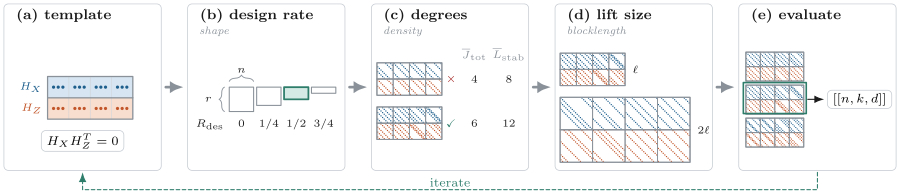
Ultra-high-rate quantum codes
Design heuristics for quantum LDPC codes that store many logical qubits per physical qubit — a [[95,22,11]] code beats the distance-11 surface code at low error rates.
arXiv 2026

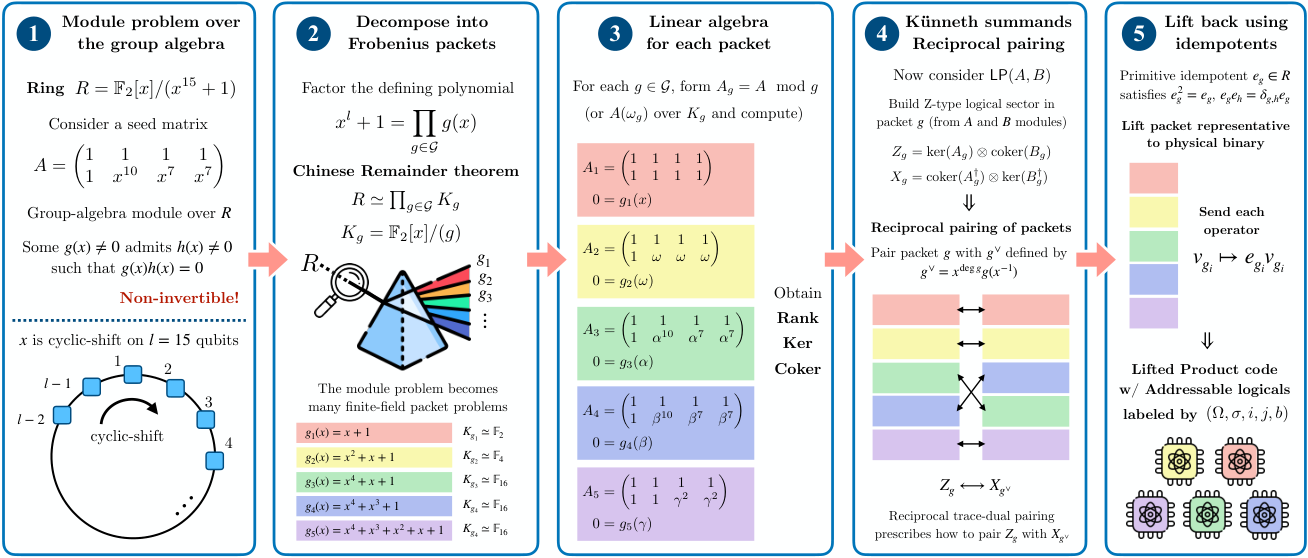
Logical spectroscopy
Lifted-product codes whose logical operators come with an addressable basis, obtained from the spectral decomposition of a group algebra.
arXiv 2026

Logical CCZ state cultivation
A factory that makes logical CCZ states — the resource behind Toffoli gates — directly inside high-rate qLDPC codes, at lower cost than cultivating T states and converting them.
arXiv 2026

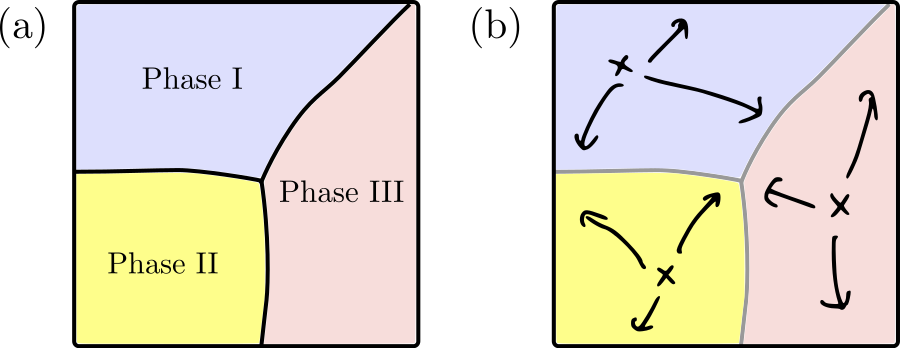
Topological mixed states
An axiomatic, entanglement-bootstrap definition of phases of matter for mixed states, and what topological order means when a system decoheres.
Phys. Rev. X 16, 041002 (2026)

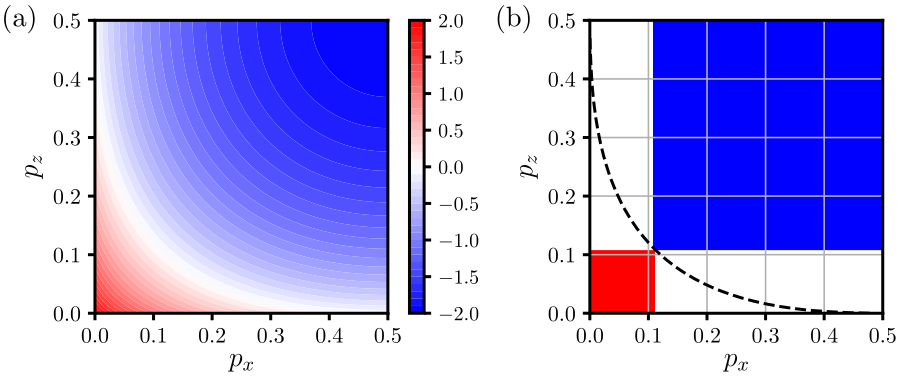
Quantum criticality under decoherence
How a critical ground state changes under decoherence or weak measurement, and the new universality classes that appear.
PRX Quantum 2023

Hydrodynamics from Lindbladian spectra
The low-energy spectrum of a Lindbladian encodes the emergent hydrodynamics of dissipative many-body systems, from diffusion to subdiffusion.
Phys. Rev. Lett. 2023
news
| Oct 15, 2026 | New preprint with Tai-Hsuan Yang, Andrew D. Kim and Akash Vijay: Stability of Quantum LDPC States under Local Pauli Noise — Proves that the code-space state of any qLDPC code stays stable under local Pauli noise: its conditional mutual information decays exponentially across a buffer, at both weak and strong noise. |
|---|---|
| Oct 14, 2026 | New preprint with Yuta Hirasaki: Logical CCZ state cultivation — Logical CCZ states enable Toffoli gates, a central building block of fault-tolerant quantum arithmetic. |
| Oct 08, 2026 | New preprint with Akash Vijay: Short-Range Vector Spin Glasses: Parisi Hierarchies and Real-Space Ultrametricity — A local lattice model of vector spins that, at large N, hosts stable one-step and full Parisi replica-symmetry-breaking phases, with the Parisi hierarchy showing up directly as correlation lengths in real space. |
| Oct 05, 2026 | New preprint: Designing Group-Valued Codes with Full Regular Low-Weight Bases — Efficient fault-tolerant quantum computing architectures benefit from low-weight logical operators. |
| Oct 02, 2026 | Jong Yeon is one of five Software Track winners of Microsoft’s Quantum Pioneers Program, for the project From Logical Spectroscopy to Hardware-Aware qLDPC Compilation, which builds on the group’s work on logical spectroscopy. The award comes with a $200,000 gift from Microsoft. |